
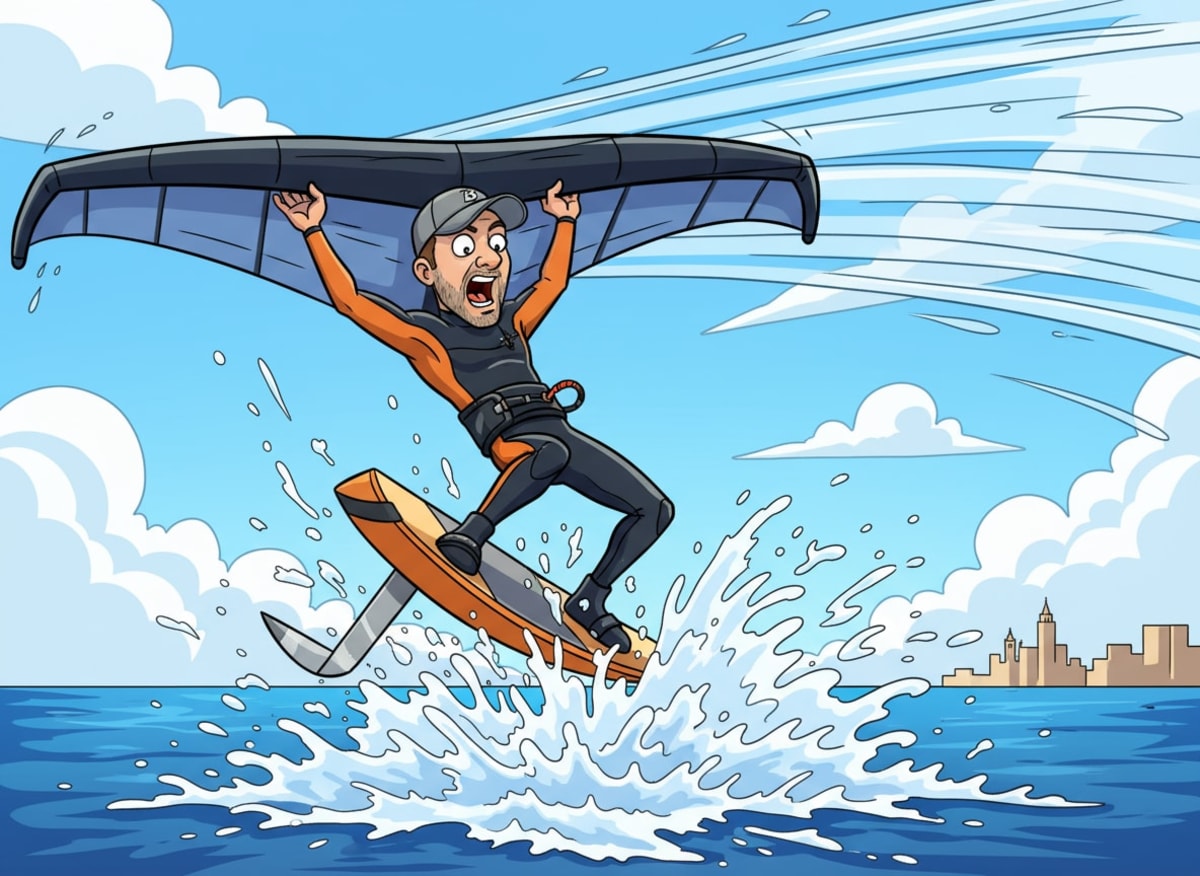
Your First 6 Seconds on Foil: Why That Spectacular Crash Is Actually the Moment You Become a Wing Foiler
The Short Version
- That first moment the hull clears the water, a strange silence takes over — the chop disappears, the drag disappears, and every sensory reference you trained for drops out from under you.
- Sports scientists call it 'proprioceptive loading': even when your conscious mind is completely overwhelmed during a crash, your nervous system is logging every millisecond of balance, pressure, and spatial position.
- Gallagher Beach in Buffalo works as a learning spot precisely because the seawall cuts Lake Erie's fetch — real wind arrives without the waves that would make early sessions genuinely dangerous.
- On gear, the volume floor for most adults is 100–140L minimum, and going smaller too fast is the difference between actually learning and just surviving each session.
- The single biggest flight-length unlock turned out to be fixing your gaze on the horizon instead of looking down at the board — two days after making that change, session length doubled.
I still have a scar on my foot from Gallagher Beach — and I wouldn't trade that moment for anything. Because those first 6 seconds on foil are exactly when I stopped being a guy who wanted to wing foil and became one. There's a version of that crash in every wing foiler's story. This is mine, and in a lot of ways, it's already yours too.
What Actually Happens in Those First 6 Seconds on Foil
What Actually Happens in Those First 6 Seconds on Foil
Nobody warns you about the silence.
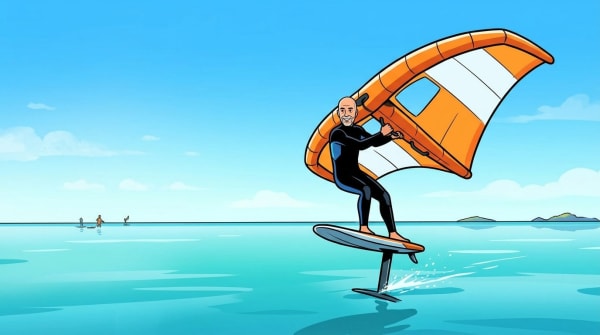
You've practiced your beach drills. You've watched the videos. You think you know what your first time on foil is going to feel like — the wing pulls, the board lifts, and then somewhere in that sequence you're supposed to be flying. What nobody tells you is that the moment the hull clears the water, a strange quiet takes over. The chop disappears. The drag disappears. Your whole sensory reference system just... drops out from under you.
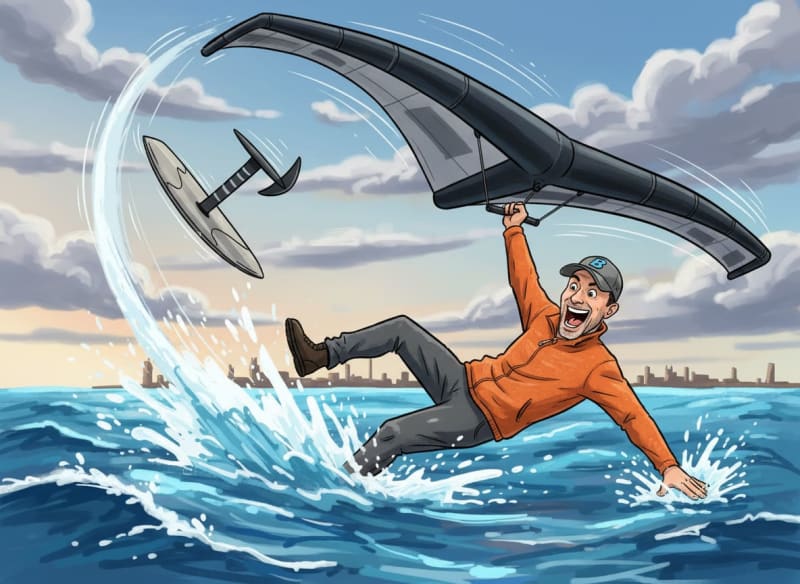
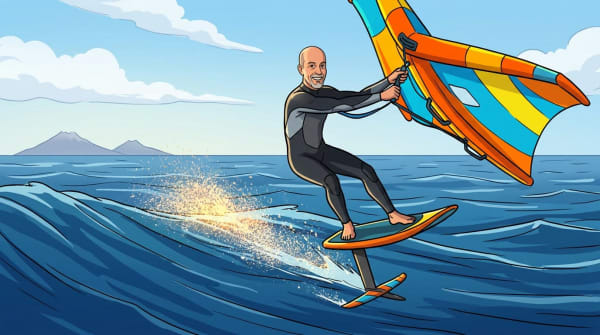
I remember it clearly at Gallagher Beach. South swell pushing in off Lake Erie, the board rising beneath me exactly the way I'd visualized it a hundred times, and then — absolutely nothing went the way I'd practiced on the beach. Not the wing angle, not my weight distribution, not where my eyes were. Six seconds of chaos, and then I was underwater, looking up at my board drifting away from me.
Here's what I want you to hold onto: your nervous system was logging every single millisecond of that cartwheel. Sports scientists who study motor learning call this "proprioceptive loading" — your body is collecting data about balance, pressure, and spatial position even when your conscious mind is completely overwhelmed. The crash isn't a failure. It's your first real data point. The wipeout is proof you got there, not proof you can't.
So before you do anything else, reframe the crash. You didn't blow it. You made it. What does it feel like to look at that wipeout as your opening move instead of your first mistake?
Why the Great Lakes Are a Surprisingly Perfect Place to Learn Wing Foiling

Why the Great Lakes Are a Surprisingly Perfect Place to Learn Wing Foiling
There's a persistent myth that you need ocean conditions to learn wing foiling properly. Having learned on Lake Erie, I can tell you that's wrong — and Great Lakes wing foiling has some genuine advantages that ocean learners will never know.
Flat to choppy inland water builds fundamental balance faster than surf in a lot of ways. Without a shore break to manage or a rolling swell to time, you can focus entirely on wing control and board feel. The water is forgiving in a way that actually accelerates the early learning curve.
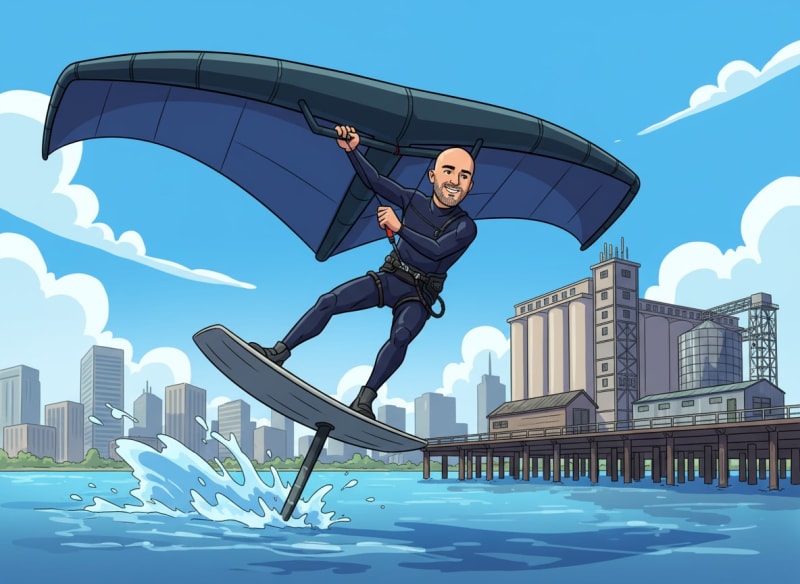
Gallagher Beach in Buffalo is the spot. That seawall protecting the Outer Harbor from Lake Erie's serious fetch is one of the best natural learning features I've foiled near — you get real wind without the waves that would otherwise make those first sessions genuinely dangerous. The community that's gathered there is small, tight, and wildly generous. Someone will always help you derig when you've blown your session. Someone will always know what the thermals are doing by mid-morning.
Fair warning, though: Gallagher Pier has a certain atmosphere. The abandoned grain elevator looming over the harbor gives the whole place a post-industrial, slightly dystopian vibe that you'll either love or find unsettling. More practically — the bottom is old bricks and debris. Wear booties. This is not optional advice.
What the freshwater foiling community lacks in numbers it makes up for in culture. These are people who drove to a breakwater in Buffalo to fly above a Great Lake. They found each other without a guidebook. That kind of self-selected crew tends to be exactly the kind of people you want beside you when you're learning something hard.
The Gear Setup That Gave Me My First Real Flight (And What I'd Change Now)
The Gear Setup That Gave Me My First Real Flight (And What I'd Change Now)
Wing foil gear for beginners is one of the most confusing rabbit holes in the sport — everyone has an opinion, the technology is evolving fast, and the price of getting it wrong is real money. So I'll just tell you what I actually ran.
I started on a Naish inflatable 140L board paired with a 2500cm² front wing and an 85cm mast. That combination was forgiving in the best possible way — the large front wing generates lift at lower speeds, which means you're not chasing high-end power just to get the board off the water. What I'd change: Don't use an inflatable board - they are too mushy.
On volume: fight the urge to go small too fast. For most adults, 100–140L minimum in your first sessions is not just helpful — it's the difference between learning and just surviving. A larger board lets you stand up, feel the wind, and focus on wing control instead of spending all your energy not falling off. The gear community consensus on this is strong, and I agree with it completely.
For the wing itself, I was running a Naish 5m or 6m in 12–18 knots at Gallagher. It was a first-generation wing — functional, but not that great compared to what's available now. I've since moved to Duotone, and the difference in handling and depower is significant enough that I wish I'd started there. That said, starting on imperfect gear isn't a tragedy. It teaches you to feel the wind rather than rely on the equipment to compensate.
The best move I made in those early sessions wasn't a gear purchase — it was borrowing and demoing before committing. The Gallagher crew passed gear around freely, and that generosity shaped what I eventually bought. If you have access to a community like that, use it. The community move is to demo first, always.
The Three Body Mechanics That Separate a 6-Second Flight From a 60-Second One

The Three Body Mechanics That Separate a 6-Second Flight From a 60-Second One
Wing foil technique doesn't live in instruction manuals. It lives in conversations between sessions, over a water bottle, when someone who's been at it longer than you looks at what you're doing and says "try this one thing."
Here are the three pivotal corrections I had to make:
1. Front foot pressure timing. Most beginners apply front foot pressure too early — you feel the board lifting and instinctively push down to control it, which drives the nose back toward the water. The correction is counterintuitive: let the lift build a half-beat longer than feels comfortable before you engage front foot pressure to level off. But you want your rise to be gradual, or you will stall the foil. Your body will resist this. Train it anyway.
2. Mast foot positioning relative to your center of gravity. Where the mast foot sits on your board changes everything about how the foil pitches under load. Too far forward and the foil wants to dive; too far back and it breaches. Finding your neutral position is a session-by-session calibration — mark what works with tape on your tracks so you're not guessing every time you rig.
3. Where your eyes actually go. This was the one nobody told me, and it was the biggest unlock. The moment I stopped looking down at the board and fixed my gaze on the horizon, my sessions doubled in length within two days. It sounds almost too simple to be true. It's completely true. Your body follows your eyes in foiling the same way it does in skiing, surfing, and cycling — the moment you look at the problem, you create it.
These three corrections are not things you can fully learn from reading them. They're things you feel. And the fastest way to feel them is to be around people who've already felt them and can spot what you're doing wrong from thirty feet away. What was your breakthrough mechanic? I'd genuinely love to know — the answer is different for almost everyone, and that conversation is worth having in the comments.
Why the Crash Is the Rite of Passage — Not the Enemy

Why the Crash Is the Rite of Passage — Not the Enemy
Learning to wing foil has a real barrier of entry. Financially, physically, emotionally — it asks something of you that most watersports don't. A complete beginner setup runs anywhere from $1,000 to $3,000 new. The learning curve is steep. And the spectacular wipeout is public, visible, and witnessed by everyone on shore.
Every single one of those people onshore has had the same crash. They know exactly what it cost you to get there. That's not performance pressure — that's recognition.
Here's what surprised me most at Gallagher: I crashed many, many times across those early sessions, and none of them hurt. What I expected to be the scariest part — being near the foil — turned out to be far less of an issue in the protected conditions there than it becomes later when you're in surf or pushing more aggressive riding. The foil stays down. You come off the board. The separation happens naturally. That fear you're carrying about the hardware? It's worth respecting, but don't let it be the reason you don't get in the water.
The people who push through those early wipeouts become the ones who will help the next person through theirs. That's not a metaphor — that's the literal social structure of this community. The crash is not a personal failure. It's your entry fee into a tribe that is genuinely stoked to have you. And the tribe has been waiting.
What to Realistically Expect Across Your First Five Sessions
What to Realistically Expect Across Your First Five Sessions
Here's an honest session-by-session map for wing foil progression — no hype, no compression of the timeline.
Session 1: You are learning taxi mode and wing control. You will not fly. This is not a bad session — this is a critical one. Getting comfortable powering up, spilling wind, and moving the board without panicking is the foundation everything else sits on.
Session 2: More taxi, more balance on the board. You're starting to feel the board want to lift and learning how to respond rather than react. This session feels slow. It isn't.
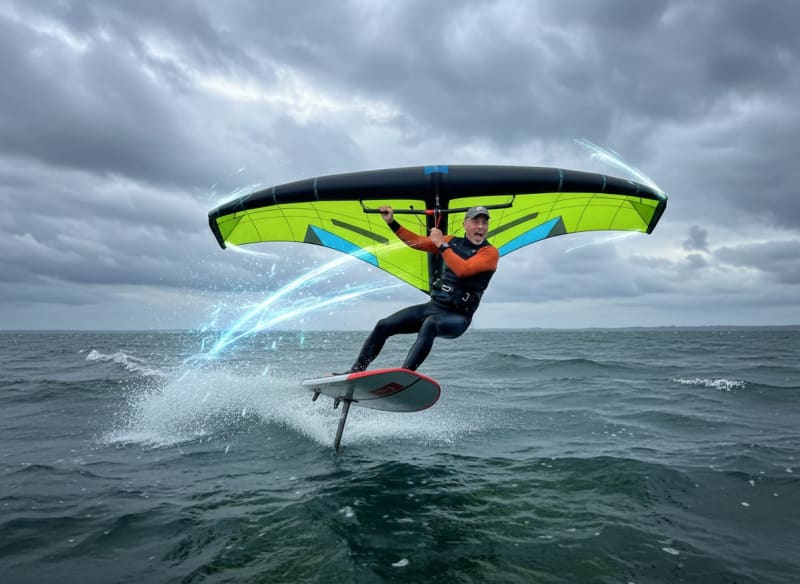
Session 3: Your first real liftoff attempt. It will be brief, probably surprising, and almost certainly followed by a swim. This is the 6-second crash we've been talking about. It counts.
Sessions 4–5: This is where the short flights start linking up. Six seconds becomes ten. Ten becomes twenty. You start to feel what "balanced on foil" actually means in your body rather than just your brain.
The plateau between sessions 2 and 4 is where most people quit. It's real, it's frustrating, and it's also completely temporary — but only if you have people around you who can tell you that from experience. Find your people before you hit that wall. Don't try to grind through it alone.
At Gallagher, the conditions I found most productive were 18-21 knots, onshore, mid-morning before the lake thermals build, and no boat traffic. The seawall eliminates the wave variable entirely, which means you're solving one problem at a time instead of three. That matters enormously in the early sessions.
By session 5 or 6, something clicks that I genuinely cannot describe in advance. Other foilers have tried, and they all use different words for the same moment. That gap between description and experience is actually the point — it's the thing that can only happen to you, in the water, when your body finally understands what your brain has been trying to explain to it for weeks.
Every wing foiler you've ever watched glide effortlessly across the water has a version of that 6-second crash in their story. The scar on my foot from Gallagher is just one version. Yours is already in progress — so consider it written, and come find us at the beach.
Content ID: EbKh2elMPrHzyEqhfHdFxAUJ
See an error? Tell us.
Comments
Share with the Community