
Wing Size for Conditions: The Practical Guide to Knowing Which Wing to Rig
The Short Version
- At 15 knots, most intermediate riders are choosing between a 6m and 7m — not a 5m and 6m — unless skill and foil efficiency genuinely justify going smaller.
- A two-wing quiver of 4m and 6m covers approximately 80% of foilable days for a 75–90kg mid-aspect rider at a typical Great Lakes or East Coast spot.
- High-aspect foils (aspect ratio 9+) generate lift at 7–8 knots, extending the effective low-end of any wing by half to a full meter — the foil and wing interact in ways most size charts ignore.
- Longer masts reduce breach risk by giving the foil more vertical range before it exits the water; they're also the better choice in big waves where depth keeps the foil flying through troughs.
- In gusty vs. steady conditions, the same wind reading calls for a different wing — trust the trend, not the current snapshot, and when in doubt the first two minutes on foil will tell you everything.
Standing on the beach with two wings at your feet — this is the moment every wing foil wing size guide eventually leads to. The forecast said 15 knots. The trees say less. The water looks somewhere in between. You have your 6m and your 7m. Which one goes in the bag?
This guide is for riders past the first-setup stage. You know how to ride. What you want is a faster decision on the beach — one grounded in the actual relationship between wind speed, body weight, foil, and the conditions in front of you.
The core logic is simple: wing area equals power. More area works in lighter wind; less area keeps you in control when it's sending. Everything else — how heavy you are, which foil you're running, whether the water is flat or choppy, how the wind is trending — modifies that core relationship. Once you have the framework, the beach decision gets cleaner.
The Core Rule: Wing Foil Wing Size Follows Wind Speed and Your Weight
The Core Rule: Wing Foil Wing Size Follows Wind Speed and Your Weight
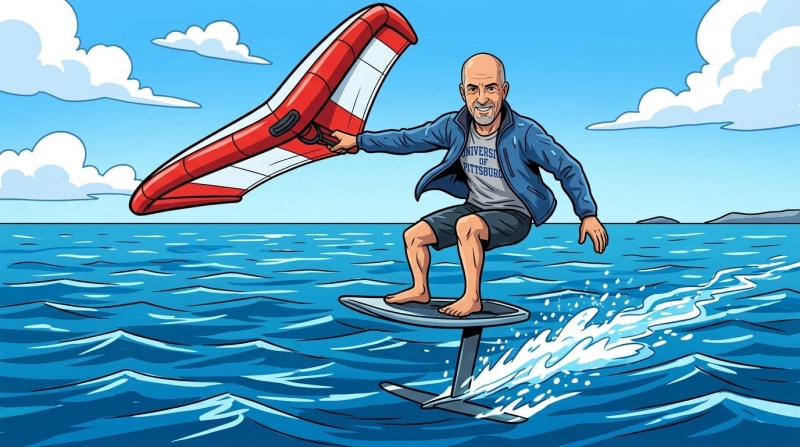
The baseline: an 80kg rider on a mid-aspect foil in moderate chop. From there, the wind-to-wing-size ladder runs:
- 3–3.5m — 22+ knots, strong-condition days
- 4–4.5m — 18–24 knots, power days
- 5–5.5m — 14–20 knots, the workhorse window for most spots
- 6–7m — 10–16 knots, light wind and early-morning glass
Body weight shifts every one of those numbers. The general rule: subtract 0.5–1m² for every 10kg above 80kg, and add 0.5–1m² for every 10kg below. A 100kg rider who needs a 5m at 20 knots is reaching for a 4m or 4.5m in those same conditions. A 65kg rider can make a 4m work in wind that would leave a bigger rider waterstarting repeatedly.
Here is how that weight adjustment plays out as a recommended wing size on a 17-knot day — a strong foiling day for the Great Lakes and East Coast:
One more variable at the core level: your foil's aspect ratio. A high-aspect front wing — the Armstrong UHA series runs above aspect ratio 9 — generates lift at speeds as low as 7–8 knots. That efficiency extends the effective low-end of whichever wing you're holding, allowing you to use half to a full meter smaller in light conditions compared to a mid-aspect rider. More on this below.
Wing Foil Wing Size Chart: Matching Wind to Your Wing
Wing Foil Wing Size Chart: Matching Wind to Your Wing
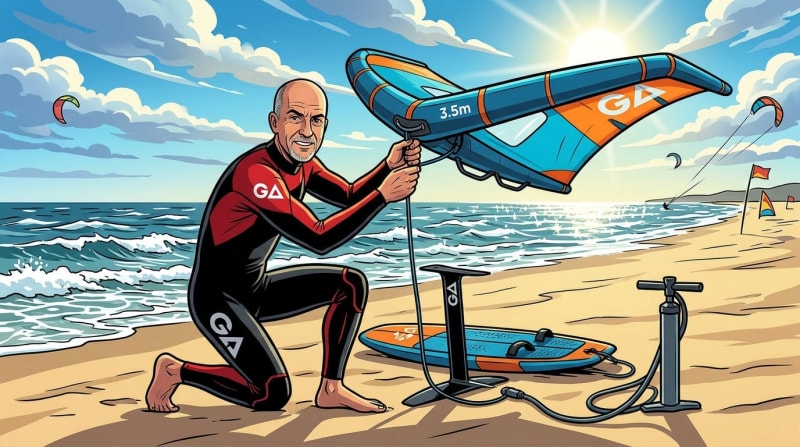
The overlap zones in any wing size chart aren't a flaw — they're the point. Real conditions are never a single number; they're a range that shifts with skill, foil choice, and water state.
Midpoint optimal wind speeds for each wing size, for a baseline 80kg rider on a mid-aspect foil:
The overlap between adjacent sizes is intentional and useful. What determines the right call within the overlap zone:
Skill level — Experienced riders are comfortable at the edges of a wing's wind range. If you're still building consistency on foil, give yourself margin and size up at the crossover point.
Water state — Flat water is efficient. Every pump transfers cleanly, and your foil's lift is unobstructed. You can push the lower edge of a wing's stated range. Chop interrupts that transfer — when the water is messy, plan for more wing.
Wind quality — Steady 16 knots and gusty 16 knots are different days. A steady 16 works fine on the lower edge of a 5m. Gusty 16 — spiking to 22 and dropping to 12 — is usually a 5m day outright. The gusts will overpower you on a 6m; the lulls will leave you dragging on a 4m.
For a real-world professional benchmark at the upper end: at the GWA Tarifa event, where the Levante runs a consistent 20–35 knots, professional athletes rig 3.5–4.5m wings. In consistent, powerful conditions, even elite riders go small.
Reading the Conditions Beyond Wind Speed
Reading the Conditions Beyond Wind Speed
Wind speed gets you close. These factors close the gap.
Flat water vs. chop
On flat water, every pump transfers directly into lift and speed — your foil's efficiency is fully expressed. You can push the lower edge of a wing's wind range because the physics are working with you. Chop introduces inconsistency: the board meets resistance between pumps, energy transfer stutters, and the foil loses flow. In choppy conditions, riders consistently need more wing than the wind reading alone suggests.
Wind direction
Side-shore wind — parallel to the beach — gives the cleanest apparent wind. As you move across the breeze, you generate faster apparent wind than the actual reading and can often ride half a meter smaller than the chart baseline suggests.
Onshore wind is gustier and less consistent as it crosses the water's edge. Offshore is usually cleaner and steadier, but carries the consequence of drifting if you go down. In offshore conditions, most experienced riders size up slightly — not because the wind demands it, but because easier water starts when you're farther out are worth the tradeoff.
Gusty vs. steady
Steady 18 knots: your 4.5m is right in its window. Gusty 18 knots — spiking to 25 and dropping to 12 — is usually a 5m day. The extra area carries you through the lulls. Yes, you'll be briefly overpowered in the spikes, but that's manageable. Spending half the session unable to get on foil in the lulls because you sized down for the peaks is not.
Manufacturers are engineering this understanding directly into their gear. The Eleveight GT4+ updated for 2026 revised its canopy profile specifically to improve low-end lift in the 4–5m sizes, targeting the 14–20 knot window more aggressively. The VAYU EOS V3 takes the opposite approach — optimized for low drag in strong-condition 18+ knot riding in 3.5–4.5m sizes. Different tools for different parts of the range.
What does your spot actually reward — range across the full wind window, or peak performance when it's fully powered?
When Your Foil Changes the Decision
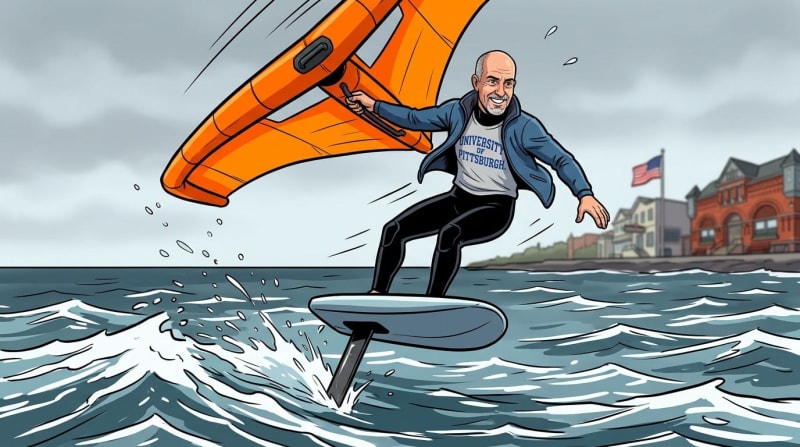
When Your Foil Changes the Decision
This is the factor most wing size charts skip, and it shifts the numbers enough to matter.
Your front foil's aspect ratio changes the effective wind window of every wing in your quiver. Ignore this interaction and your sizing decisions are built on incomplete information.
high-aspect foils (AR 9+)
The Armstrong UHA series and similar ultra-high-aspect designs generate lift at speeds as low as 7–8 knots. These foils are exceptionally efficient — low drag, fast between pumps, on foil earlier than anything else. The practical result: you can ride a wing that's at the low end of its stated wind range and still stay on foil consistently. You get half to a full meter smaller than the chart baseline.
Mid-aspect foils (AR 5–8)
This is where most intermediate riders live. Standard performance front wings need real board speed to generate lift, which means the wing has to do full work to get you there. Stick to the midpoint of the reference chart. You don't have the low-speed efficiency to cheat the numbers.
Lower-aspect foils (AR 4–5)
More stable and forgiving — strong for learning and great downwind tools. They require more power to get on foil, which means one wing size larger than the baseline chart in light conditions. In stronger wind, the added stability works in your favor.
Here is how foil aspect ratio shifts the minimum practical wing size at 15 knots for an 80kg rider:
Mast length
A secondary factor worth naming: Armstrong's carbon mast range runs 60–90cm, with the 75cm as the all-around choice for wing foiling and 85–90cm recommended for downwind. Longer masts (75–90cm) reduce breach risk — more mast length means the foil has more vertical range to work with before it exits the water, giving you more time to correct when it rises. They're also the better choice in big waves, where the added depth keeps the foil flying through wave troughs rather than breaching when the board lifts. Shorter masts (60–65cm) are more agile and well-suited for flat-water sessions, but offer less recovery margin in gusty or choppy conditions.
The Borderline Call: Tips for the 50/50 Session
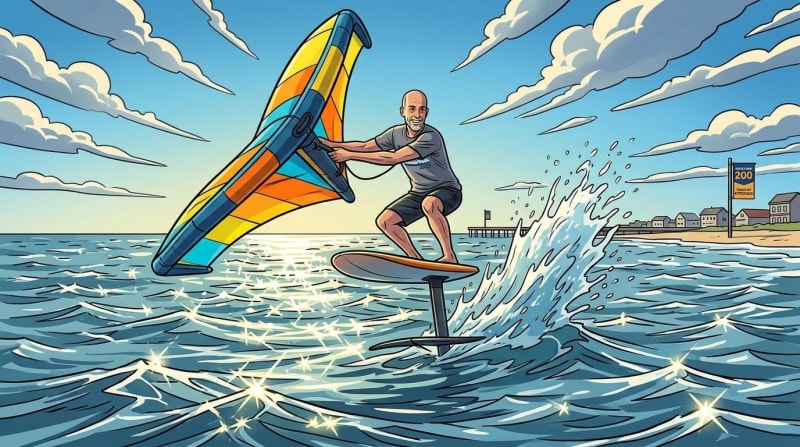
The Borderline Call: Tips for the 50/50 Session
You've read the forecast. You've looked at the trees. You're standing between your 5m and your 6m, and it could genuinely go either way.
Here's the decision framework, in priority order:
1. Forecast trend
Building or dropping? If it's building through the afternoon, rig the smaller wing now and gain confidence as conditions fill in. If it's dropping, rig the bigger wing — fading wind is the most common scenario that puts riders on the wrong side of repeated waterstarting.
2. Your condition today
Tired? Coming off a rest week? Rig the bigger wing. A tired rider burns energy faster, makes worse decisions, and recovers more slowly from mistakes. More wing means less work to stay on foil, and more margin for the off pumps.
3. Distance from shore
The farther you're going, the more the bigger wing makes sense. Repeated water starts in fading wind half a kilometer from the beach is a bad place to discover you sized wrong.
The most common borderline mistake: rigging the smaller wing in fading conditions because the current reading still looks playable. An hour later you've done twenty water starts and the session is over. Trust the trend, not the current snapshot.
"The wing always knows before you do. You just have to ask it."
The fastest way to ask: rig, do one test glide before committing. Get on foil once, read what the wing is telling you. Experienced riders know in the first two minutes. If the wing feels like it's working with you, stay on it. If you're fighting for every meter of progress, go back and upsize.
Building Your Quiver: What the Numbers Say
Building Your Quiver: What the Numbers Say
This is where sizing logic becomes a real decision about gear and money.
Single-wing riding
If you're on one wing and based on the Great Lakes or East Coast, the 5m covers more foilable days than any other size. The average foilable wind window for these locations runs 12–18 knots. The 5m sits right in the middle of that range for a 75–85kg rider on a mid-aspect foil. It's not the most exciting answer, but it's the correct one.
Two-wing quiver
A 4m and a 6m covers approximately 80% of foilable days for that same mid-weight rider. The 4m handles 18–24 knots; the 6m handles 10–16 knots. The gap between them sounds large, but in practice most locations don't offer consistent foiling in the 16–18 knot borderline zone anyway — conditions tend to be clearly one or the other.
If your spot skews windier (consistent 18+ knots), shift the quiver up: 3.5m + 5m. If it skews lighter (consistent 10–14 knots), shift down: 5m + 7m.
Three-wing quiver
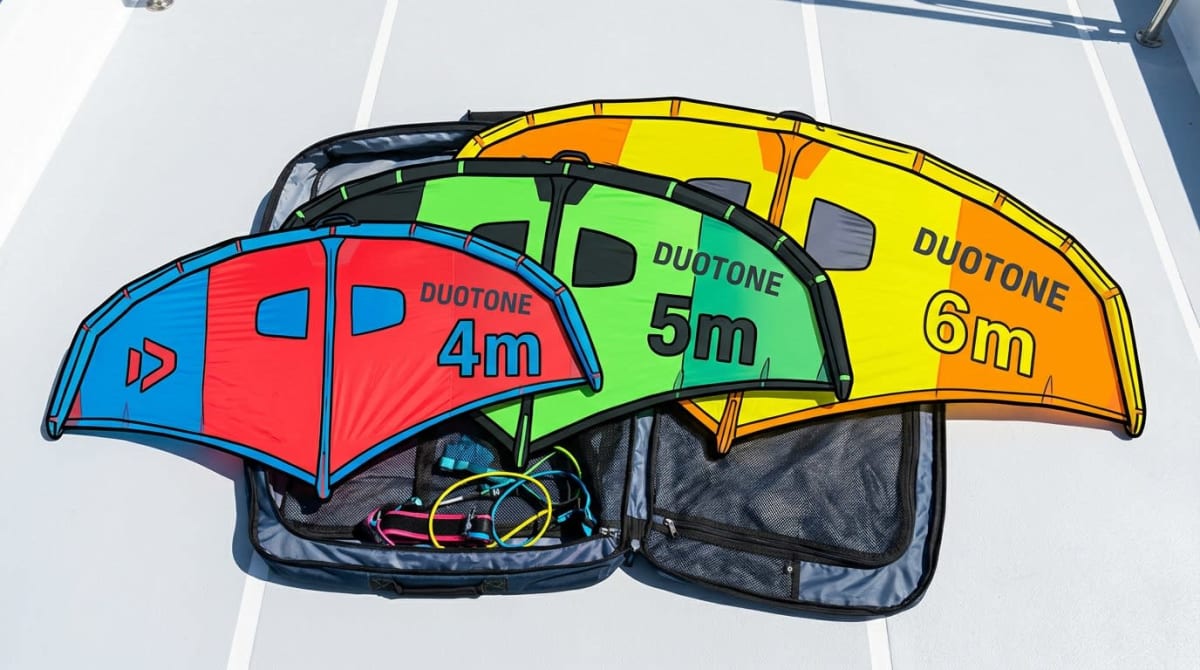
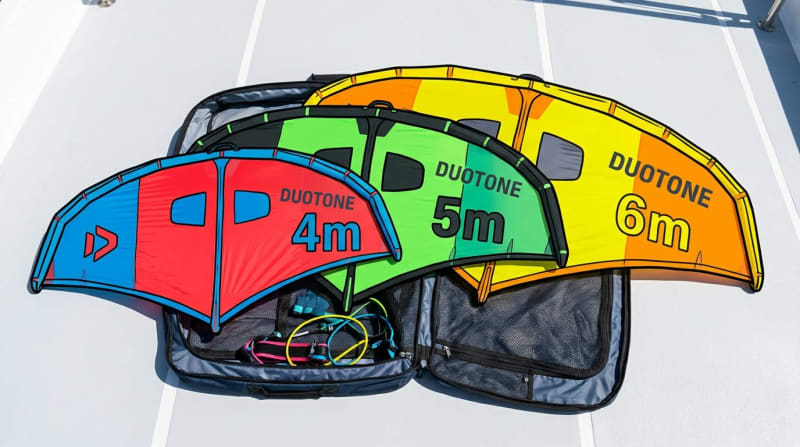
A tighter three-wing spread — 4m, 5m, and 6m — is what many riders actually end up with, and for good reason. The gaps between sizes are manageable, each wing covers a realistic chunk of conditions, and you're never more than one size away from dialed-in. Running a Duotone 4m/5m/6m quiver, I've found this configuration handles the vast majority of conditions without any wasted wing in the bag. For riders who want to push into the fringes, a 3.5m + 5m + 7m covers a wider spread — roughly 92% of foilable days — but the 7m becomes a specialized piece you may only reach for a handful of sessions each season.
Real talk on cost: wing prices increased meaningfully after 2025 China tariff adjustments added roughly 10% to the base price of most wings under $1,000. Most riders get better return from investing in a better foil or coaching than from adding a third wing they'll use infrequently. Make the quiver decision honestly.
Here's how quiver configuration affects foilable day coverage for a 75–90kg mid-aspect rider at a typical Great Lakes or East Coast spot:
The community wisdom on this is consistent: ride what you have, ride it often, and let the gaps in your quiver teach you what you actually need before you fill them. The people who are always on foil aren't the ones with the most wings — they're the ones who know exactly which wing to reach for.
What would the right quiver unlock for you — more days on the water, or more confidence in the days you already have?
Content ID: QzHS4H3UFb94fZYj4rsNd139
See an error? Tell us.
Comments
Share with the Community