

The Armstrong A+ System: What 'One Foil for Every Day' Actually Means for Real Riders
The Short Version
- The Armstrong A+ foil system is built around a single premise: one calibrated setup covering roughly 12-32 knots so most riders can stop accumulating wings and start riding.
- The system is most valuable for intermediate riders, travelers, and anyone who hasn't yet built a full quiver — it's a harder case to make if you already own three wings you know exactly when to deploy.
- Modular compatibility with Armstrong's existing mast and fuselage lineup means current Armstrong riders can adopt the A+ System without rebuilding their entire setup from scratch.
- The A+ System does not replace dedicated sub-10-knot light-wind specialists or purpose-built surf foils — Armstrong doesn't claim it does, and that honesty is part of what makes the design philosophy credible.
- Armstrong's Everydayers series — which profiles non-pro riders in their 60s riding multiple sessions per week — signals that the A+ System is designed for real riders in real conditions, not just team riders in perfect ones.
The gear conversation at any wing foil beach tends to have a familiar shape. Someone rigged up the wrong setup for the day — they know it immediately, and so does everyone watching. They're fighting to stay on foil in the lulls while another rider pumps through effortlessly on something bigger. Or they're getting thrown around in chop while someone else is locked in on a tighter, snappier wing. The problem isn't always skill. Often it's the setup. And the conclusion most riders reach is the same one: they need another front wing.
The Armstrong A+ foil system is a direct answer to that loop. The positioning is explicit: "One System, All Time." Not versatile. Not do-it-all. All time. Every session, every condition, every rider level — one set of gear.
That claim is worth examining carefully, because if it holds up, it changes how you think about buying gear entirely.
The Problem the A+ System Is Trying to Solve
The Problem the A+ System Is Trying to Solve
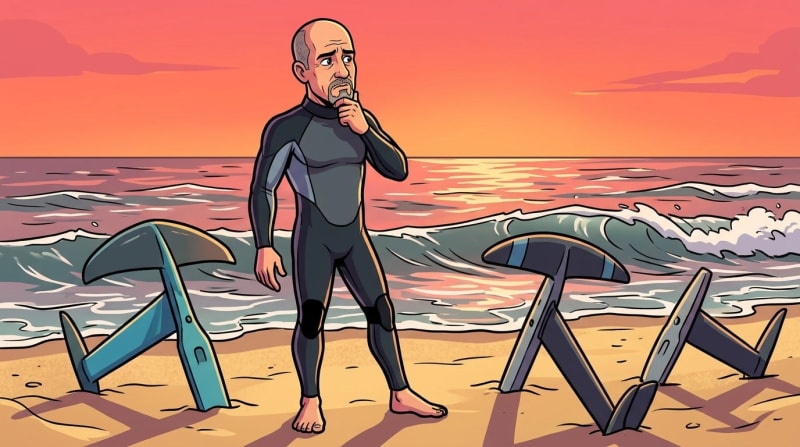
Wing foiling has a gear accumulation problem that unfolds in recognizable stages. You start with one setup — whatever the shop had or whatever an experienced friend recommended as a beginner package. Then you progress, and your starter front wing starts to feel like a ceiling. You buy something more performance-oriented. Then a light-wind day arrives and you're underpowered, so you add something bigger for early lift. Then you start riding surf and discover your flat-water wing behaves completely differently in chop. Somewhere around year two or three, you have three or four front wings and a recurring question about which one to rig.
Armstrong's own writing on the A+ System acknowledges this pattern directly — riders accumulate setups not because they want a full quiver, but because they're chasing condition coverage one wing at a time. Each purchase makes sense in isolation. The system as a whole becomes expensive and confusing.
The quiver growth pattern looks roughly like this across the typical rider arc:
The "all time" philosophy behind the Armstrong A+ foil system is a direct answer to the year-three or year-four problem: multiple setups, multiple beach decisions, diminishing returns on each new wing. The argument is that the A+ front wing's condition coverage compresses that progression — that the in-between wings you reach for when you're not sure what the day will deliver become unnecessary.
What does your quiver situation actually look like right now? If you're already hesitating on the beach, that's worth sitting with before the next purchase.
Inside the Armstrong A+ Foil System

Inside the Armstrong A+ Foil System
The Armstrong A+ System centers on a redesigned front wing with specific performance targets: early lift without instability at speed, a broad usable wind window, and modular compatibility with Armstrong's existing hardware.
The "system" framing matters here. Armstrong isn't just releasing a new front wing profile. The A+ design integrates the fuselage geometry, tail wing ratio, and mast interface as a calibrated package — not a front wing you mix and match with whatever tail you have in the garage. The tail wing and fuselage are specifically tuned to the A+ front wing's lift curve and pitch characteristics. Armstrong has applied engineering learnings from their SailGP technology partnership — where racing-grade foil development informs recreational product design — directly to the A+ System's geometry.
For existing Armstrong riders, the modular story is the most immediately practical detail: the A+ System uses Armstrong's standard mast and fuselage interface. Your mast works. Your fuselage transitions to the new system. That significantly lowers the barrier to entry compared to switching foil platforms entirely.
What you do need to understand is that the A+ System performs as designed when run as Armstrong intends — front wing, paired tail, and fuselage as a matched set. The modular compatibility gives Armstrong riders an on-ramp; it is not an invitation to mix A+ wings with non-Armstrong components and expect the same results.
Here is how the A+ System's intended wind range compares to typical specialist alternatives:
The A+ System's target window spans roughly 12-32 knots for intermediate to experienced riders — covering the range that two or three separate wings previously handled. That is the core of the claim.
How It Performs in Real Conditions

How It Performs in Real Conditions
The most detailed public data point on the A+ System in use comes from Armstrong's A-Sessions series, in which team riders Oskar and Jeremy tested the system across multiple locations and varying conditions — including their documented search for a barrel that moved them through different wind windows and water states. Their accounts describe both flat-water performance and how the system engages in surf.
In the 12-18 knot range — where most riders spend most of their on-water time — the A+ System provides early lift without the pitch sensitivity that can accompany high-aspect light-wind foils at speed. It does not perform like a pure light-wind specialist. It will not put you on foil at nine knots. But in the conditions where wing foiling is genuinely enjoyable rather than a survival exercise, it holds its range across the window without requiring a wing swap as wind builds through the session.
In stronger conditions and surf, the A+ System shows less pitch hunting than larger all-around wings, which lets riders engage waves without the front wing surging through the face. This is where the fuselage-tail calibration becomes evident: the system stays stable when the rider transitions from wing power to swell power. The GWA World Tour has moved toward this broad-range foil philosophy at the competitive level — wide-range performance rather than condition-specific specialists — which gives the design direction credibility beyond recreational marketing.
Here is an honest performance profile for the A+ System across condition types, based on Armstrong's stated design targets and rider reports from the A-Sessions series:
The 70 in light wind is intentional and honest — the A+ System is not a light-wind specialist, and the chart reflects that accurately. The 95 in moderate wind reflects where the system is most precisely calibrated. A three-wing quiver with the right wing selected for every session would score higher in each individual condition. What the A+ System trades is peak-condition performance for consistent reliability across the full range — one setup that scores well everywhere rather than one that scores perfectly somewhere.
Who the A+ System Is Actually For

Who the A+ System Is Actually For
Armstrong's Everydayers series profiles non-professional riders who use Armstrong systems as a regular part of their lives — including riders in their 60s who wing foil multiple sessions per week. The series is a deliberate signal about design intent: Armstrong is building for riders who don't have a coach selecting their setup and who aren't flying to perfect conditions. They're designing for the person who shows up at the beach with one bag and makes it work.
The A+ System fits that rider profile closely.
Intermediate riders who are progressing past their starter setup but haven't yet built out a full quiver are the clearest fit. The A+ System provides a capable, high-ceiling wing that won't become their "light conditions only" wing in twelve months. It grows with the rider rather than becoming a specialty item they reach for only on the right day.
Traveling riders are the second obvious fit. If you wing foil on vacation, in unfamiliar spots, or at destinations where wind and water conditions are genuinely unpredictable, carrying a three-wing quiver is neither practical nor efficient. One A+ System in one bag covers the likely range of conditions you'll encounter without the guesswork.
Riders who want to simplify before accumulating a full quiver are also in the A+ target window — and the cost reality is worth being direct about:
A comparable-quality three-wing quiver from any major brand runs roughly $2,400-3,600 at retail. The A+ System sits well below that threshold while delivering similar condition range — not identical, but close enough that many riders would never notice the gap in the conditions they actually ride.
The honest question before any gear purchase: are you at the stage where the A+ System solves a real problem you actually have right now? If you're already deep into a multi-wing quiver and know exactly which wing to rig on which day, the A+ System is a different value proposition than it is for the rider still building toward that knowledge.
What It Does Not Replace

What It Does Not Replace
The A+ System represents honest gear philosophy, and honest gear philosophy names what a system doesn't do.
The sub-10-knot specialist. If you specifically chase 8-10 knot sessions — ultra-light wind, pump foiling in near-zero conditions, or downwinding in marginal wind that barely qualifies as wing foiling — the A+ System is not your best option. Dedicated light-wind specialist wings with very high aspect ratios and maximum surface area will outperform the A+ System in those marginal conditions. Armstrong doesn't claim otherwise, and neither should anyone selling you this system.
The dedicated surf foil. Riders who have moved fully into surf foiling — chasing waves primarily, using the wing only to get out the back — will find purpose-built surf foils with specific wave-engagement geometry outperforming an all-around system when the conditions are right. The A+ System handles surf well. It is not a replacement for a dedicated wave setup if surf is your entire program.
The elimination of beach decisions. Buying the Armstrong A+ foil system does not mean you stop reading conditions. You still assess the day. You still know what the wind is doing and what the water looks like. What the A+ System changes is how often your single setup is the right answer when you show up — which, for most riders in most conditions, turns out to be most of the time.
"One System, All Time" means capable across conditions — not perfect in every condition. That distinction is the difference between useful gear marketing and genuine design philosophy.
The wing foil community has a generosity to it that shows up at every beach. Riders who've sorted their gear share what worked. The rider who bought the wrong thing at the wrong stage tells you honestly so you don't make the same call. That's the whole culture of this sport — information flows freely because people remember what it felt like not to know.
The Armstrong A+ foil system is a genuinely interesting answer to a real problem — the quiver accumulation loop that catches most wing foilers somewhere between year two and year four. Whether it's the right answer for where you are right now depends on the kind of rider you're becoming. That's the question worth sitting with before you open your wallet.
If you're at the stage where the answer feels obvious — come find out what it's like to show up at the beach and not have to think about which wing to rig.
Content ID: w3wDE3z96UDVo3gMysAnc400
See an error? Tell us.


Comments
Share with the Community