
Wing Foiling Anna Maria Island: Gulf Sessions, Tampa Bay Flatwater, and Everything You Need to Know Before You Go
The Short Version
- Anna Maria Island's seven-mile Gulf-facing shoreline delivers one-to-three-foot swell with a gradual sand shelf — a genuine gift for beginners who need time to set up a water start without shore break chaos.
- Tampa Bay flatwater, especially at Fort De Soto Park and the Skyway area on a southeast wind, goes glassy enough to feel every micro-adjustment on the foil, making it one of the best skill-building venues a traveling foiler can find.
- March through May is the sweet spot for a trip: southeast trade winds run more consistent, temperatures are warm without being punishing, and the Gulf side gets its most reliable side-on flow.
- Florida averages around 20–30 unprovoked shark incidents per year statewide out of tens of millions of ocean visits, and local foilers manage the real-but-small risk by avoiding dawn and dusk sessions and steering clear of visible baitfish activity.
- Traveling with an inflatable wing — the author ran a Duotone 5M — solves the vehicle space problem cleanly, though a shorter 60cm travel mast would have added confidence at shallower Bay launch zones.
I had no idea that wing foiling Anna Maria Island would turn into one of my favorite sessions of the year. What I found was a destination that genuinely delivers for foilers at every level. Wide Gulf beach launches with forgiving shore break. Glassy Tampa Bay flatwater just a short drive away. And a vibe that let me be fully present as a dad and partner and still get on the water. That combination is rarer than it sounds.
If you've been quietly wondering whether a wing foiling travel destination can also be a place your family actually wants to go, keep reading.
Why Anna Maria Island Belongs on Every Wing Foiler's Radar

Why Anna Maria Island Belongs on Every Wing Foiler's Radar
Anna Maria Island doesn't announce itself. There are no highrise hotels crowding the shoreline, no jet ski rental kiosks every fifty yards, no scene. What you get instead is Old Florida — pastel cottages, a single main road, pelicans sitting on dock pilings like they own the place. The island runs about seven miles long and maybe a mile wide, which means you're never far from either the Gulf or the Bay, and the whole thing moves at a pace that lets a vacation actually feel like a vacation.
I didn't come here as a foiler scouting a destination. I came as a dad who wanted to take his family somewhere easy, warm, and not completely overrun. The sessions were almost incidental. But here's the thing about AMI — because it isn't a watersports hotspot in the way that Canaveral or Hookipa is, there's no territorial energy. You're not competing for launch windows with forty kiteboarders. You're not navigating a beach break crowded with bodyboarders. You have room to set up, to breathe, to actually enjoy the pre-launch ritual instead of rushing through it.
That's what makes this a wing foiling travel destination worth building a trip around — not that it's a foiling mecca, but that it fits around a real life. If the people you travel with have historically tolerated your foiling hobby rather than celebrated it, AMI might be the place where that changes. The beaches here are genuinely beautiful. The restaurants are worth it. The sunsets are absurd. And while your crew is watching the sun drop into the Gulf, you can be replaying the session in your head with a cold beer in hand, and everyone is happy.
Have you been waiting for the foiling trip that doesn't require you to compromise your life to go on it?
The Gulf-Side Launch: Reading the Beach Conditions at AMI
The Gulf-Side Launch: Reading the Beach Conditions at AMI
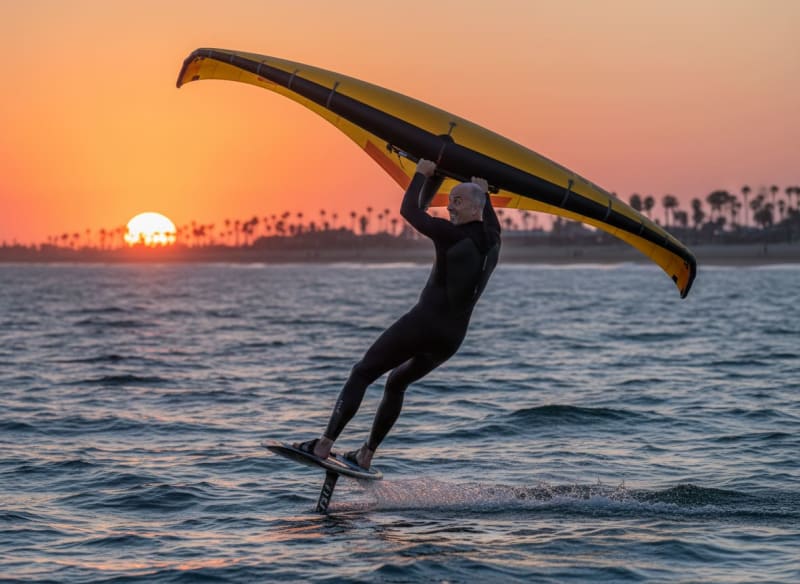
Standing on the Gulf-facing beach at Bean Point — the northern tip of the island where the beach widens into a long crescent of open sand — holding your wing and looking out at the water is genuinely one of those moments. On the morning I launched, the sky was overcast in that soft, even-pressure way that experienced foilers learn to appreciate. No thermal convection pulling the wind in weird directions. No gusty afternoon sea breeze building before you're ready for it. Just steady, readable pressure.
For a Gulf of Mexico beach launch wing foil session, AMI's west-facing beaches offer something that more exposed Atlantic-facing beaches don't: consistently small swell. Gulf swells typically run one to three feet, often less, and the sand shelf here is gradual enough that you get a long wade-out through ankle-to-knee-deep water before you need to commit to riding. That's gold for beginners who haven't nailed the beach launch yet, and it's still plenty interesting for experienced foilers who want to work on their gybe transitions in open water. And it CAN get crazy.
Reading the Wind Direction by Season
Wind on the Gulf side at AMI runs predominantly from the southwest in summer — onshore to slightly side-onshore, which keeps you off the beach but doesn't push you into a nightmare crossing angle. Spring brings more southeast flow from the trades, which gives you a side-off angle on the Gulf beach and is, honestly, the better foiling wind: cleaner, more consistent, and it lets you run downwind without immediately ending up on someone's towel. The local rule of thumb is that if it's blowing from the south or southeast at 12 knots or better, the Gulf side is on.
On overcast days like the one I launched in, the thermal component drops out almost entirely and what you get is synoptic wind — the real stuff, from the actual pressure gradient rather than local heating. Fewer lulls. Fewer gusts. Easier to read, easier to commit.
The Launch Sequence: Beginners vs. Experienced Foilers
For newer foilers, the gradual sandy bottom here is a genuine gift. You can walk your board out until you're thigh-deep, get your wing up and sheeted in to feel the power, and then attempt your water start without the urgency of shore break pushing you around. Bean Point and Manatee Beach (at the south end of the island, with a proper parking lot) were both spots I used — Manatee Beach has better amenities and a slightly more protected angle, while Bean Point gives you more room and better southwest exposure.
Experienced foilers will want to read the shore break timing before they launch. Even at one to two feet, if the sets are stacking closer together than you'd like, wait for a lull and use it. The wade-out is the only tricky part; once you're flying, it's open Gulf in front of you.
Tampa Bay Flatwater Sessions: The Secret Weapon for Foil Practice

Tampa Bay Flatwater Sessions: The Secret Weapon for Foil Practice
If the Gulf side is vacation mode — beautiful, forgiving, photogenic — Tampa Bay flatwater wing foiling is where the real skill-building happens. The Bay is protected. On the right tide and wind angle, it goes genuinely glassy, the kind of surface that lets you feel every micro-adjustment on the foil without chop interference. For someone dialing in their upwind riding, their tacks, or their low-altitude control, it's almost unfair how good it can be.
The wind funnels through the Bay in a way that creates consistent pressure without the volatility of open ocean exposure. Southeast flow, especially in spring, loads up the northern reaches of the Bay beautifully. And because kiters and foilers have been working this venue for years, you're not arriving into a vacuum — there's a community here, and they're generally welcoming to traveling foilers who show up with good energy and decent water awareness.
Where to Launch on the Bay Side
Fort De Soto Park, at the mouth of Tampa Bay on the Pinellas side, is the name that comes up most often in local crew conversations. The launch area near the boat ramp gives you access to protected water with room to maneuver, and the park itself is worth a half-day even if the wind doesn't cooperate. The Skyway area — near the base of the Sunshine Skyway Bridge on the Manatee County side — is another spot local foilers use when the south wind is on, offering a long fetch downwind run with a clean angle back. Apollo Beach, further north along the eastern shore of the Bay, is flatter and more sheltered, better for absolute beginners or for days when you want zero drama.
If you pull into any of these spots and see gear on the beach, introduce yourself. The Tampa Bay foiling and kiting community is the kind that actually shares what they know — launch windows, which tides to avoid, which directions work for which spots. That community knowledge is more valuable than anything I can put in a trip report, and it's available to you if you ask.
Gear That Travels Well: What I Packed and What I'd Change
Gear That Travels Well: What I Packed and What I'd Change
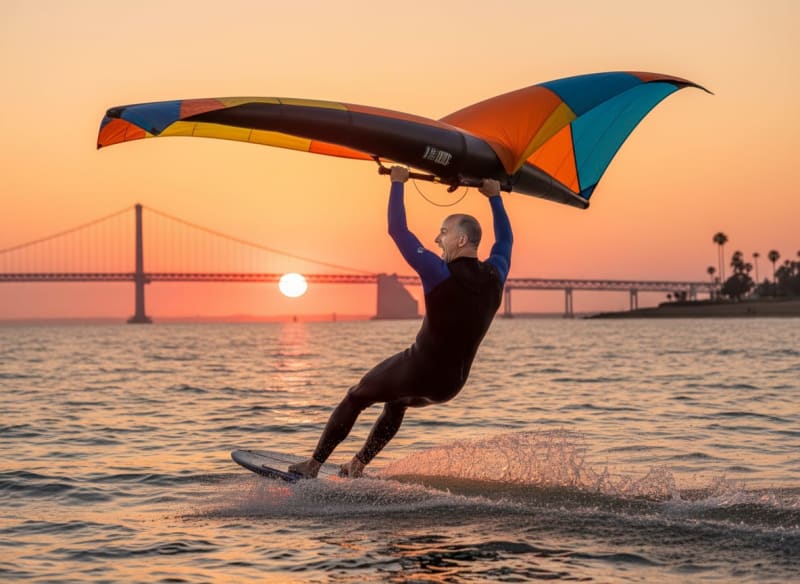
The photo from that morning at Holmes Beach tell most of the story: Duotone wing (5M), inflatable Naish foil board (100L) with the full hydrofoil setup attached (1400 front foil), standing on the sand looking out at the Gulf. Inflatable wings win for road trips, full stop. I was running the Duotone, and the ability to break it down into a bag that fits in the back of a small SUV alongside beach gear is not a small thing. A comparable rigid frame wing would have required a different vehicle or a different trip.
For a wing foiling travel gear setup, the calculus comes down to what you're willing to manage on the road versus what you're willing to sacrifice in performance. Inflatable boards have closed that gap considerably over the last few years — the Duotone leading edge stiffness and the responsiveness of the canopy in real conditions surprised me, especially in the >20 knot range that AMI's Gulf side delivered.
What I'd Do Differently
The foil board travel situation is the honest challenge. A proper board bag that doubles as padding and fits inside the vehicle is worth the investment — you want something with enough foam thickness to protect the rails and tail, and ideally with backpack straps for the beach walk. The foil itself — mast, fuselage, wings — breaks down and packs into a hard-shell case that slid into the cargo area with room to spare.
The thing I'd add next time: a shorter travel mast. My standard 85cm mast is fine for the conditions, but a 60cm option would have given me more confidence in the shallower Bay launch zones and taken up less space in the vehicle. If you're on the fence about whether the logistics of traveling with foil gear are worth it — they are. It just takes one trip to figure out your system, and after that it's routine. I'm done with the inflatable board, buying the folding carbon one - which I will write about after I have a few sessions on the water.
Practical Trip Planning: Timing, Tides, and Who to Connect With Locally

Practical Trip Planning: Timing, Tides, and Who to Connect With Locally
This is the section I wish had existed when I was planning that first trip. Anna Maria Island wind conditions and trip planning don't require you to guess if you have the right framework — so here it is.
Best months to visit: March through May is the sweet spot. Southeast trade winds are more consistent during this window, temperatures are warm without being punishing, and the Gulf side gets its most reliable side-on flow. October and November are a close second — cold fronts start pushing through from the north, delivering strong, clean NW-to-NE flow that lights up the Bay side in particular. Avoid July and August unless you're comfortable with lighter, less predictable thermal winds and afternoon thunderstorm windows that can shut things down fast.
Tide windows for Tampa Bay: The Bay has a tidal range of roughly two feet, which is enough to matter at shallow launch sites like the Skyway area. Higher tide gives you a cleaner launch at spots with grassy flats; lower tide can expose sandbars that complicate your approach. Check NOAA tide charts for the Manatee River entrance or the St. Petersburg station — both are close enough to be relevant.
Local shops and community: The Bradenton-Sarasota corridor has a handful of watersports shops worth knowing. Island Water Sports in Sarasota and Wind & Water Sport in the broader area are worth a call before you arrive — they can tell you current conditions, whether anyone's been launching nearby, and whether they can help with a repair if something goes sideways. For the community layer, the local Facebook groups are active: search for Tampa Bay kiteboarding and foiling groups and introduce yourself before you arrive. These crews are exactly the kind of people who respond to "I'm coming in March, any tips?" with a three-paragraph breakdown and a phone number.
The whole reason to write something like this is so the next foiler who packs their wing for AMI doesn't have to piece it together from scratch. When you get there and learn something new, come back and share it. That's how this works.
Yeah, About the Sharks: What You Actually Need to Know
Yeah, About the Sharks: What You Actually Need to Know
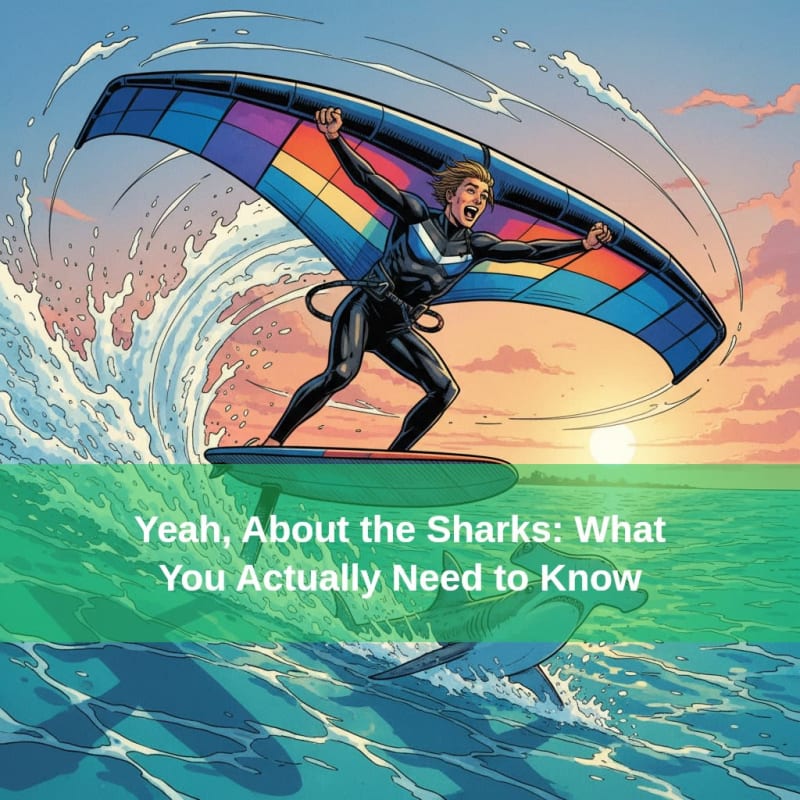
I'd be doing you a disservice if I didn't bring this up directly - the sharks. After ten sessions over two years at AMI and around the Tampa Bay area, I finally saw a shark. Six to eight feet, calm and unhurried, sliding past my port side about eight feet under the surface. He didn't bother me. I didn't bother him. We went our separate ways, and I kept riding.
As a freshwater rider I can't say that this didn't startle me quite a bit and generated quite a bit of conversation with my buddies back home in upstate New York who only ride the Finger Lakes and Great Lakes.
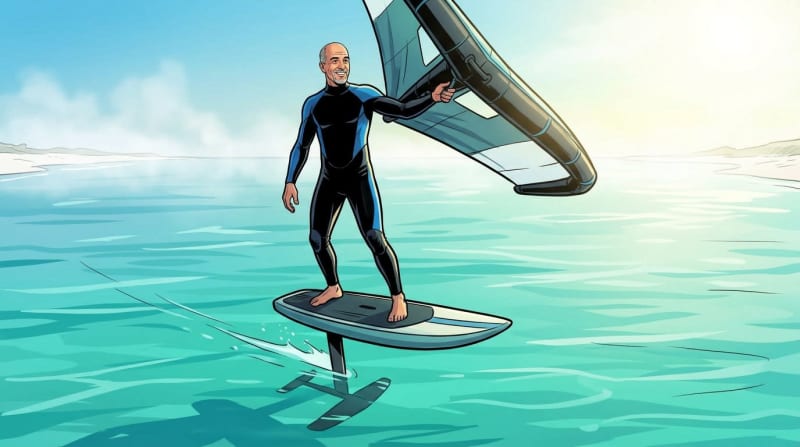
But let's talk about Sharks in Tampa Bay honestly, because shark awareness on the Florida Gulf Coast for wing foilers is a real conversation — not a reason to stay home, but not something to wave off either.
What You're Actually Likely to Encounter
The species you'll most commonly share water with in these spots are nurse sharks, blacktip reef sharks, and — particularly in Tampa Bay — the occasional bull shark. Nurse sharks are slow-moving bottom feeders that have essentially no interest in a foiler. Blacktips are common in Florida coastal waters and account for a significant portion of the state's bite incidents, though the vast majority of those involve surfers or swimmers in shallow, murky surf zones. Bull sharks are the one species that warrants genuine respect — they're comfortable in low-salinity water, they're present in Tampa Bay, and they're less predictable than the others.
To put the risk in perspective: Florida averages around 20–30 unprovoked shark incidents per year statewide, out of tens of millions of ocean visits. Fatalities are extraordinarily rare. The risk is real but statistically small — and I'd honestly argue that surfers carry more exposure than foilers, given how much time they spend sitting motionless in the water with their legs dangling below the surface. On a foil, you're moving, you're mostly above the water, and you're covering ground.
How Experienced Local Foilers Think About It

The community knowledge on shark awareness comes down to a few consistent habits. Avoid dawn and dusk sessions if you can — low-light hours are peak feeding time. After heavy rain, murky water reduces visibility for both you and the sharks, which changes the dynamic. Stay away from areas with obvious baitfish activity — diving pelicans, nervous bait balls near the surface, fishing boats chumming nearby. These are signs that something higher up the food chain is probably already interested in that spot.
None of this is fear-mongering. It's just the same situational awareness you'd apply to reading a launch beach or checking the tide chart. The local crews know this instinctively and will share it if you ask.
You're a Guest in Their Water
The most useful reframe I've found is this: you're a visitor to their ecosystem, the same way you're a visitor to any break you haven't earned local knowledge at. The sharks were here before the boat ramps and the board bags. Respect and awareness belong together — not because the water is dangerous, but because it's alive. That's actually what makes it worth being in.
The foilers and kiters who've been working these Bay and Gulf spots for years carry that awareness lightly, without drama. They're in the water constantly and they're fine. The goal isn't to eliminate the risk, it's to understand it well enough to share the water with intelligence and intention.

If you've been waiting for a sign to pack your wing on the next foil trip, this is it. Wing foiling Anna Maria Island rewards the foiler who shows up curious — curious about the conditions, about the local crew, about what the Bay looks like at first light on a southeast wind morning. The community you'll find along the Tampa Bay shoreline is exactly the kind of tribe worth being part of: people who share what they know, who are stoked to see another foil in the water, and who genuinely believe the more of us out here doing this, the better. Pack the gear. Make the drive. Let the sessions find you.
Content ID: IwyN8cysWzza0h8ev99f3TiG
See an error? Tell us.
Comments
Share with the Community