
How to Choose Your First Wing Foil Setup: The Beginner Sizing Guide That Actually Makes Sense
The Short Version
- Beginner board volume should equal body weight in kg plus 30–40 liters — an 80kg rider needs at least 110 liters, and erring toward the high end pays off in stability and learning speed.
- Front wing sizing has shifted since 2021: today's beginner sweet spot is 1500–2000cm² at mid-aspect ratio (AR 5–6.5), not the 2000–2500cm² monster foils that were standard when the sport was new.
- What counted as high aspect in 2021 (AR 6–7) is now squarely mid-aspect — current high-aspect wings run AR 10–13+ and are designed for experienced racers and downwind riders.
- Mast length for beginners should be 70–75cm, fuselage around 70–74cm, stabilizer around 250–300cm² matched to the front wing — all components should come from one brand's ecosystem to avoid compatibility headaches.
- Most riders end up with 3–4 hand wings covering their conditions — a realistic beginner quiver runs 5m through 7m, with 8m needed for very light wind inland sessions, and a single 6m wing as the best starting point for variable conditions.
The Setup Wall Every Beginner Hits
The Setup Wall Every Beginner Hits
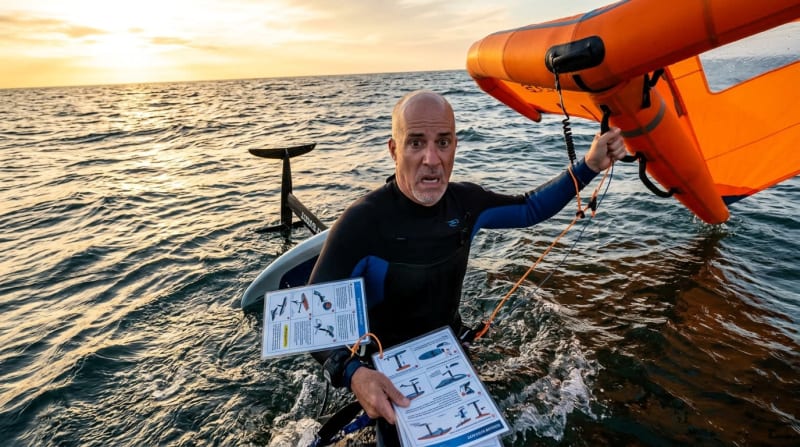
My first real session on a wing foil happened at Gallagher Beach, a protected harbor on Lake Erie in Buffalo where the breakwall flattens the water into something almost forgiving. I had a 2,500cm² front foil — enormous, low-aspect, curved like a crescent moon — and it did exactly what it was supposed to do: it lifted me off the water at embarrassingly low speeds and kept me there. For about two months, it was the right tool.
Then I tried to turn.
The foil didn't want to come with me. It had so much surface area and such a rounded profile that changing direction felt like trying to steer a barn door. I'd initiate a jibe, lean into it, and the foil would just... continue in the original direction. That experience is not unique to me — it's the wall that almost every beginner who started four or five years ago hit at exactly the same point in their progression.
Here is the good news: if you are buying your first setup today, you don't have to hit that wall. The gear has evolved significantly, the advice has caught up with it, and choosing how to choose your first wing foil setup is genuinely more straightforward in 2026 than it was when the rest of us were figuring it out.
Start Here: Your Board
Start Here: Your Board
The board is the least exciting conversation in wing foiling, which is exactly why it matters most. Get this wrong and nothing else works. Get it right and the rest of your gear has room to breathe.
The rule is simple: as a beginner, your board volume in liters should equal your body weight in kilograms plus 30 to 40 liters. An 80kg rider needs at least 110 liters. According to Natural Highs, if you are new to water sports, live somewhere with light or inconsistent wind, or simply want more margin for error, go to the high end of that range — weight plus 40.
The reason generous volume matters is not just flotation — it is time. A board that supports your weight fully gives you the mental bandwidth to focus on the wing in your hands and the foil under your feet, rather than constantly fighting to stay on top of the water. As Windance puts it, the goal is not to ride the most liters possible — it is to use that stability until your skills outgrow it. You will not stay on your first board forever, and there is a healthy secondhand market for large beginner boards when you are ready to move on.
One more thing about boards: length and width matter as much as volume. A 110-liter board shaped long and narrow flies differently than a 110-liter board shaped short and wide. For beginners, look for boards with a stable midsection width and enough length that small fore-and-aft weight shifts do not toss you immediately. As you progress, the path forward is toward longer, narrower shapes — midlengths (often called middies) and downwind boards — which offer better glide and efficiency. Those are intermediate and advanced tools. For now, stable and forgiving is the goal.
The Front Wing: Where Everything Changed

The Front Wing: Where Everything Changed
This is the part of the conversation that has shifted the most since wing foiling emerged around 2019 and 2020. And it is worth understanding why it has changed, because the reasons are instructive for choosing gear today.
When the sport was new, the conventional wisdom was simple: get as much front wing surface area as possible. The logic was sound — more area means more lift at lower speeds, which means you get off the water sooner and stay there more easily. 2,000 to 2,500cm² was a normal beginner recommendation. The wings were thick, rounded, and had an aspect ratio (the ratio of wingspan to surface area) of around 3 to 4 — short and stubby, like a wide paddle blade.

What nobody fully accounted for was the ceiling. Those wings were magnificent liftoff machines and very poor everything-else machines. At speed, the excess surface area created drag that limited how fast you could go. In turns, the rounded low-aspect shape resisted direction changes. As MACkite's gear experts noted in their 2024 trend analysis: "At first you're really stoked about riding, but then it becomes about turning, and you find you're limited on a big, low-aspect wing."
The equipment has since improved enough that you no longer need to choose between getting off the water and being able to steer once you're there. Board designs got better. Foil manufacturing got more precise. And the result, according to that same analysis, is that "even with mid-aspect wings you get less drag — coupled with the right board and wing, there's just not as much need for" the old monster foils.
What was considered a high aspect ratio in 2021 — around AR 6 or 7 — is now solidly mid-aspect. Current high-aspect wings run AR 10 to 13 and above, designed for racing and downwind foiling by experienced riders. F-ONE's foil guide puts their beginner range starting at AR 5.0 and their all-round intermediate foil at AR 6.0. That shift tells you everything about how the baseline has moved.
For 2026, the practical beginner recommendation from AFS Foiling and Poole Harbour Watersports has converged around this by weight:
The shape to look for: mid-aspect (AR 5 to 6.5), rounded outline, medium-thick profile. As Sport in Tribe describes it, a low-to-mid aspect wing "has a shorter wingspan and a thicker profile — incredibly stable and lifts out of the water at low speeds." That is still the right starting point. What has changed is that you can get those beginner-friendly properties in a wing that will also let you learn to turn.
"The foil under your board decides how early you lift and how the board feels as you gain speed. Beginners want early lift and predictable control — not the fastest possible wing."
— Windance Beginner Wing Foil Setup Guide
The Rest of the Foil: Mast, Fuselage, Stabilizer

The Rest of the Foil: Mast, Fuselage, Stabilizer
Once you have the front wing sorted, the other foil components follow logically.
Mast: Start short. ENSIS recommends 85cm or less for beginners, and AFS suggests 70–75cm as an ideal first mast length. A shorter mast keeps you closer to the water, which means falls are shorter and less dramatic, and the system is more manageable while you are learning. Longer masts (85–95cm) come later when you are riding in chop and want the clearance. Aluminum masts are perfectly adequate for learning — carbon saves weight but costs significantly more and does not change how you learn.

Fuselage: Longer is more stable, shorter is more reactive. For beginners, Sport in Tribe recommends around 74cm — enough distance between front and rear wing that the foil is forgiving of imperfect weight distribution. Once you are linking jibes confidently, shorter fuselages (65–68cm) open up tighter turning and more agile riding.
Stabilizer (rear wing): Match it to your front wing. Most brands sell matched sets for exactly this reason — mismatching aspect ratios between front and rear wing creates a foil that either hunts constantly in pitch or requires extreme body position to keep flying level. As a general rule: large front wing, large stabilizer; around 250–300cm² for beginners.
The Hand Wing: Size by Wind and Weight
The Hand Wing: Size by Wind and Weight
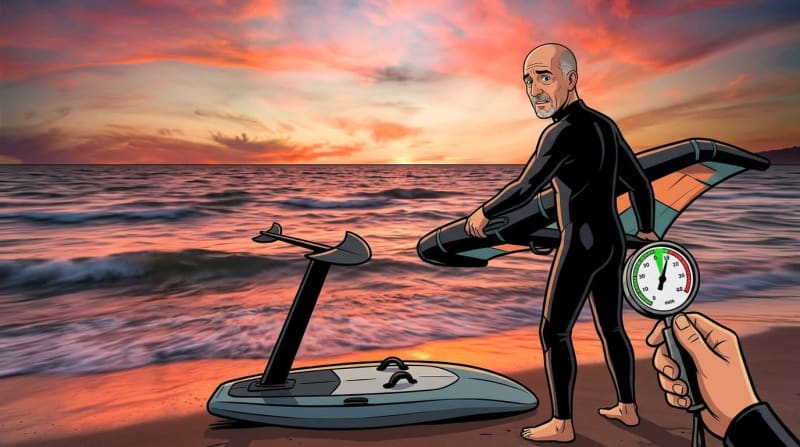
The hand wing — the inflatable sail you hold — is sized primarily by wind strength and adjusted by body weight. Most beginners can realistically get on foil in 18–25 knots of consistent wind. Below 18 knots, even experienced riders reach for bigger wings; below 15 knots, getting a beginner off the water is genuinely difficult regardless of wing size.
In that 18–25 knot learning window, the ION Club guide and Windance point toward 5–6m as the practical beginner range for most riders. Lighter riders (under 70kg) may manage with 5m in good conditions; most riders in the 70–90kg range will want 6m as their primary learning wing; heavier riders (over 90kg) should look at 6–7m.
Here is the honest truth about quivers: most riders who stick with the sport end up with three or four wings. A full practical quiver runs from around 4m (for strong wind days, 25+ knots) up through 5m, 6m, and 7m — one wing for each wind range. Riders on inland lakes, where wind tends to be lighter and patchier than coastal spots, often add an 8m for sub-15 knot sessions where they want to stay on the water. I currently ride a 4m, 5m, 6m, and 7m, and an 8m is on the list for light-wind Great Lakes days.
Start with one wing sized for your most common conditions — for most people in variable inland or Great Lakes conditions, that is a 6m. Add a second wing above or below based on what days you are missing, and build from there.
The One Rule That Overrides All the Charts

The One Rule That Overrides All the Charts
None of these charts are a substitute for standing in the water with someone who knows what they are doing.
If you have not taken a lesson yet, take one before you buy anything. A single two-hour session with an instructor at a good local spot will tell you more about what setup actually works for your body and your conditions than any sizing guide — including this one. You will also learn quickly whether the sport is for you before you commit thousands of dollars to gear.
After lessons, buy used. The secondhand wing foil market is well-stocked with large beginner setups from riders who have already made the exact progression we are describing here — they learned on the big foil, outgrew it, and are now riding something smaller and faster. Their first setup is your ideal first setup, at a fraction of the new price.
And when you do buy, buy a complete system from one brand. Prism News's compatibility analysis is blunt about what happens when you mix components across brands: mast-to-fuselage interfaces, bolt patterns, and flex characteristics vary enough that cross-brand setups routinely create problems that experienced riders can navigate and beginners cannot. One brand, one ecosystem, at least for your first setup.

The gear wall is real. I hit mine at Gallagher Beach trying to turn a barn door. But the community that shows up at spots like that — the riders who will watch you struggle for a session and then quietly tell you what they changed when they were at the same point — is also real. The equipment is a starting point. The people are how you actually get better.
What would it take for you to just get in the water?
Content ID: 9vU7mpb4E6DPxtN3nJ9WfD51
See an error? Tell us.
Comments
Share with the Community