Why Gallagher Beach Is One of the Best Kept Secrets for Learning to Wingfoil on the Great Lakes
The Short Version
- The breakwall at Gallagher Beach creates a protected pocket of flat water that is genuinely rare on the Great Lakes, turning what would be chaotic Erie chop into a forgiving learning environment.
- Lake Erie is the shallowest of the Great Lakes at an average depth of only about 62 feet, which means wipeouts near the launch stay recoverable rather than dangerous.
- Spot selection drives progression faster than gear choices — beginners fighting chaotic conditions aren't learning to foil, they're learning to survive, and those are different educations.
- Four years of returning to the same water has built body knowledge that no new spot can replicate: how gusts accelerate over the grain elevator, how the harbor mouth shifts wind angle, and how afternoon thermals build chop.
- Strong north or east winds are sessions to skip entirely at Gallagher — those directions push riders straight toward concrete, and there's no protected pocket to bail you out.
If you've been searching for the perfect place to learn wingfoiling on the Great Lakes, Gallagher Beach in Buffalo has been hiding in plain sight. I've been riding this spot for four years now — from my first wobbly liftoff to linking jibes in the harbor chop — and the more I progress, the more convinced I become that choosing the right local spot is the single most underrated decision a beginner can make. Gear debates dominate every forum thread and Facebook group, but nobody talks enough about the water beneath your board. That's what this piece is about.
What Makes Gallagher Beach a Surprisingly Perfect Buffalo Outer Harbor Wingfoil Spot
What Makes Gallagher Beach a Surprisingly Perfect Buffalo Outer Harbor Wingfoil Spot
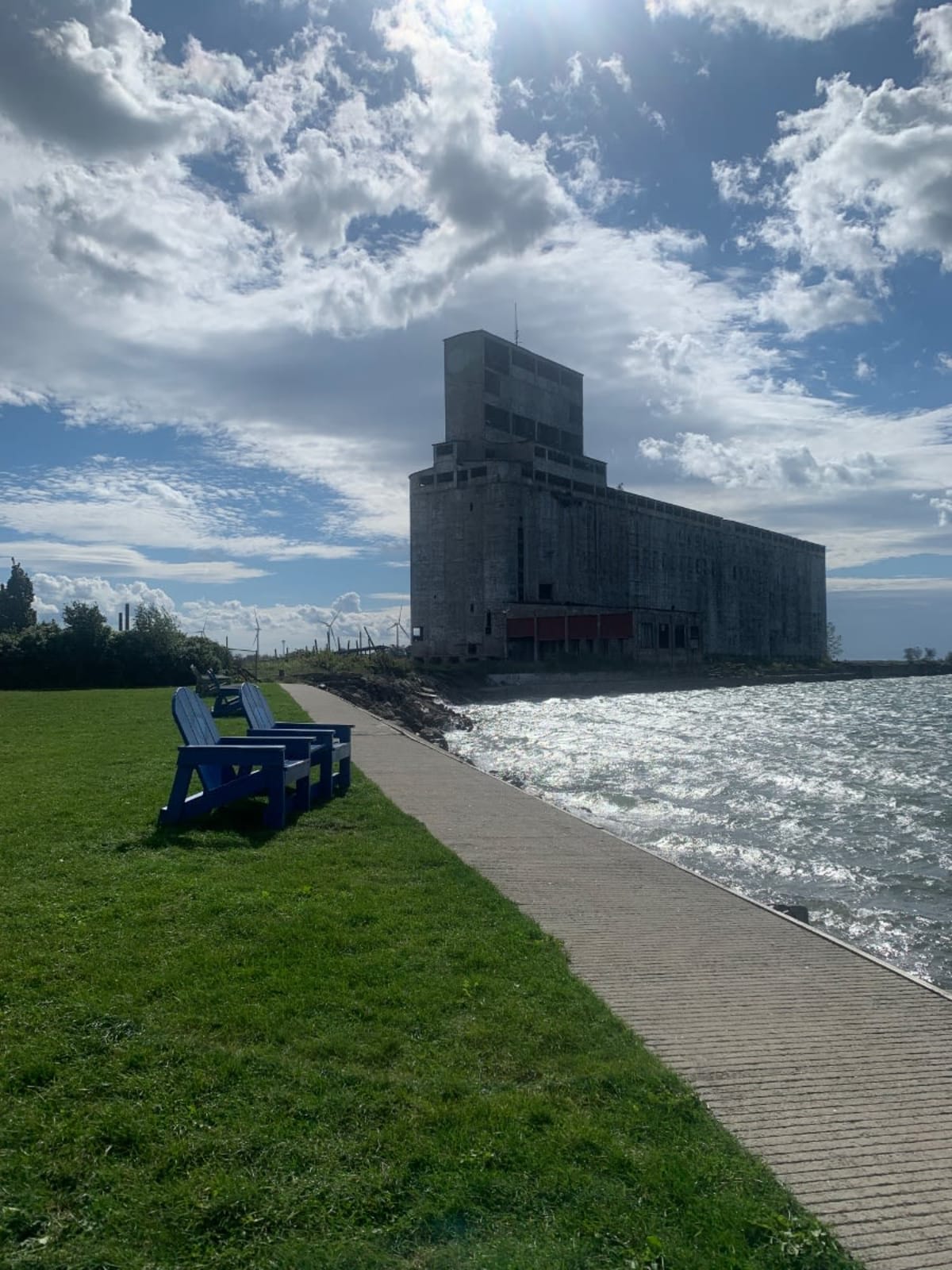
The first thing you notice when you pull into the Outer Harbor is the scale of it. The old grain elevator dominates the skyline to the north, and the breakwall stretches out into Lake Erie like it was built specifically for wingfoilers — which, obviously, it wasn't, but it performs that function beautifully. That breakwall creates a protected pocket of flat water that is genuinely rare on the Great Lakes. Anyone who's tried to learn in open Erie chop knows what I'm talking about. The difference between riding inside the harbor and fighting two-foot wind swell outside is the difference between flying and drowning in confusion.
The grain elevator isn't just a landmark — it's a wind indicator. When a southwest or west wind is wrapping around that structure cleanly, you can watch the telltales shift before you even pump up your wing. Spend enough sessions here and you start reading the elevator the way sailors read a masthead fly. Across the harbor, the wind turbines give you a secondary confirmation — if they're spinning at a good clip and aligned with what you're feeling on your face, you're probably in the window.
What I love most about the physical setup is what surrounds the water. The blue Adirondack chairs along the boardwalk path are where the tribe assembles — before sessions to check conditions, after sessions to debrief, always with someone pointing at the water and making a case for one more run. This is a spot that rewards the people who discover it. You don't just use Gallagher Beach; after enough sessions, you belong to it.
The Conditions Breakdown: Wind, Water, and What to Expect With Lake Erie Wingfoiling
The Conditions Breakdown: Wind, Water, and What to Expect With Lake Erie Wingfoiling
The money wind directions at Gallagher are SW and W, full stop. A southwest wind runs roughly parallel to the breakwall, which keeps the protected zone genuinely flat while generating enough pressure to fly. A true west wind has a bit more fetch behind it and can build some texture inside the harbor by afternoon, but it's still manageable for beginners because the breakwall is doing its job. Lake Erie wingfoiling conditions in these windows can be genuinely world-class for a freshwater flat-water setup.
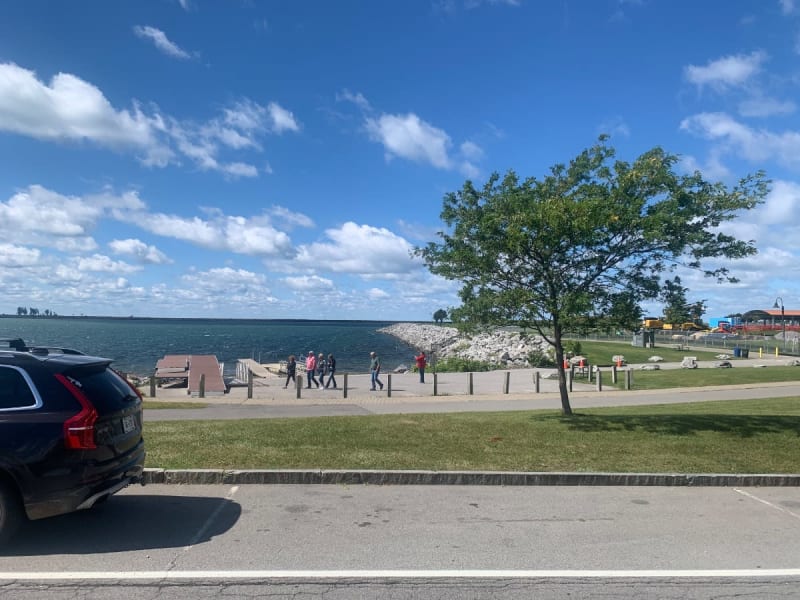
The split between inside and outside the pier matters enormously depending on where you are in your progression. Inside the breakwall you're working with chop that's typically under a foot, wind that's steadier because the fetch is limited, and a forgiving environment to make mistakes. Outside the pier, the narrow channels are built for boats, not foilers — getting out there is more trouble than it's worth, and this isn't a place to chase waves anyway. For that, nearby Hamburg or Woodlawn Beaches are your move.
A few seasonal notes worth knowing: late spring through early fall is the prime window, roughly May through October. But the shoulder season extends the calendar significantly if you're willing to suit up. Lake Erie is the shallowest of the Great Lakes, with an average depth of only about 62 feet — which sounds irrelevant until you're learning foiling and your mast is punching toward the bottom on a wipeout in knee-deep water near the launch. That shallowness is actually an advantage close to shore; wipeouts are recoverable, not dangerous.
The one thing I'll always tell newcomers: Erie conditions can change fast. A glassy morning can turn into a whitecap afternoon in under two hours. Frame that as a skill to develop, not a reason to stay home. Learning to read the sky over the lake is part of the education this spot offers.
My First Flight Here — and Why the Spot Did Half the Work When Learning to Wingfoil on Flat Water
My First Flight Here — and Why the Spot Did Half the Work When Learning to Wingfoil on Flat Water
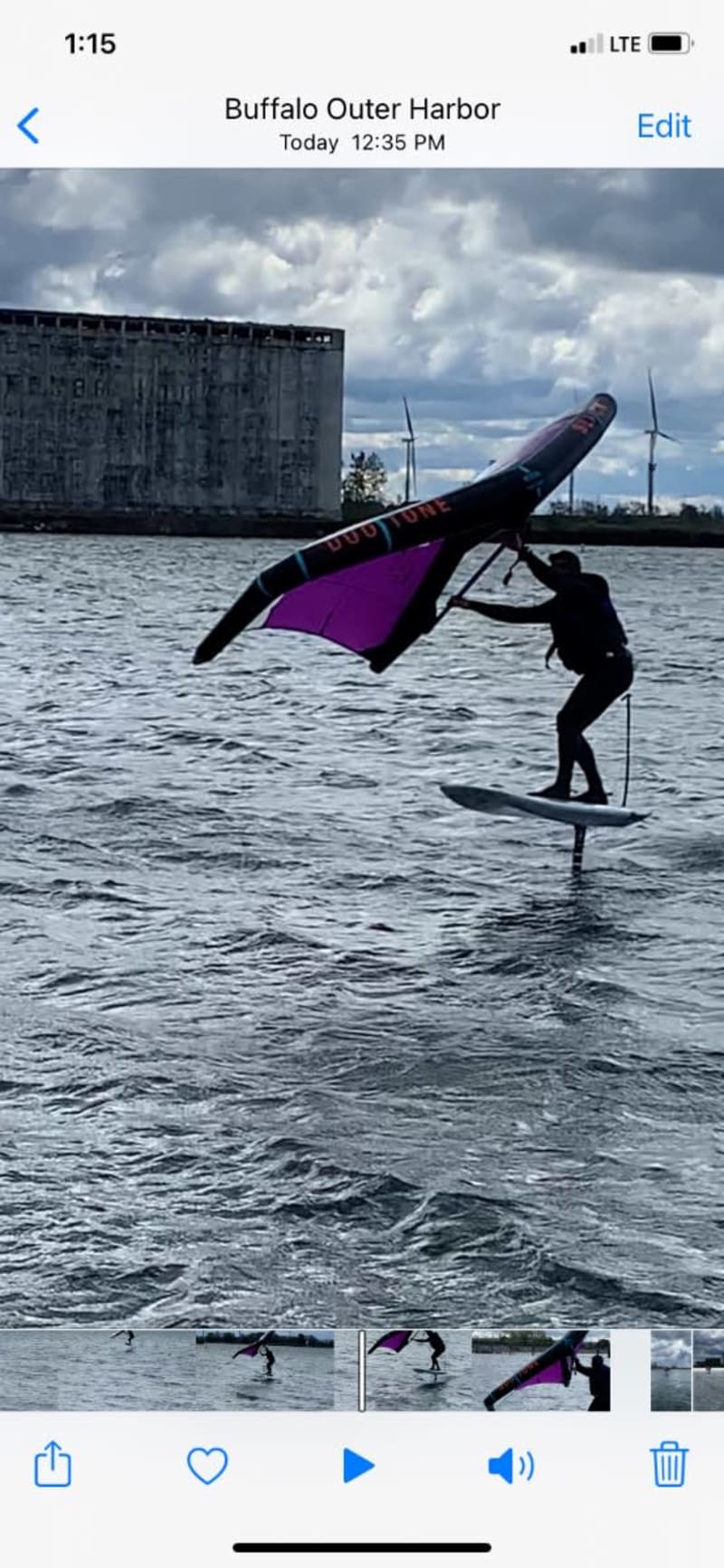
I remember the day I first got up on foil at Gallagher with the kind of clarity that only comes from a moment that changes how you see something. The conditions were textbook: a steady 15-knot southwest wind, the harbor glass-smooth inside the breakwall, nobody in my line. I'd been struggling for three sessions on a choppier spot further up the lake, and I genuinely thought my problem was fitness, or timing, or the wrong wing size.
It wasn't any of those things. It was the water state.
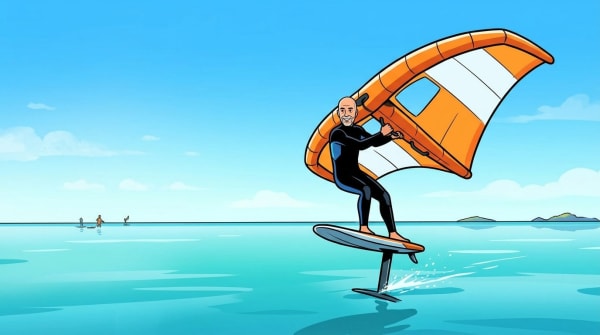
learning to wingfoil on flat water is categorically different from learning anywhere else. Every variable you're managing — weight distribution, wing angle, mast pressure, speed — is already hard enough without adding unpredictable chop that pitches the board under you before you can respond. Those early sessions at Gallagher, the ones where you're silhouetted against the grain elevator, purple or black wing overhead, tentatively unweighting your back foot for the first time — those sessions are only possible because the environment is simplified enough to let you feel what's happening.
Spot selection directly affects how fast you progress. Not your wing brand. Not your fitness level. Not even your instructor. The water state under your board is the variable that determines whether your nervous system can actually decode the feedback it's receiving. The right environment doesn't make the learning easy — it makes the learning possible. Gallagher gave me that. It gave me the room to find my own footing instead of fighting conditions that had nothing to teach me yet.
Four Years of Progression: From Wobbly Liftoffs to Linking Jibes — Wingfoil Progression on Lake Erie
Four Years of Progression: From Wobbly Liftoffs to Linking Jibes — Wingfoil Progression on Lake Erie
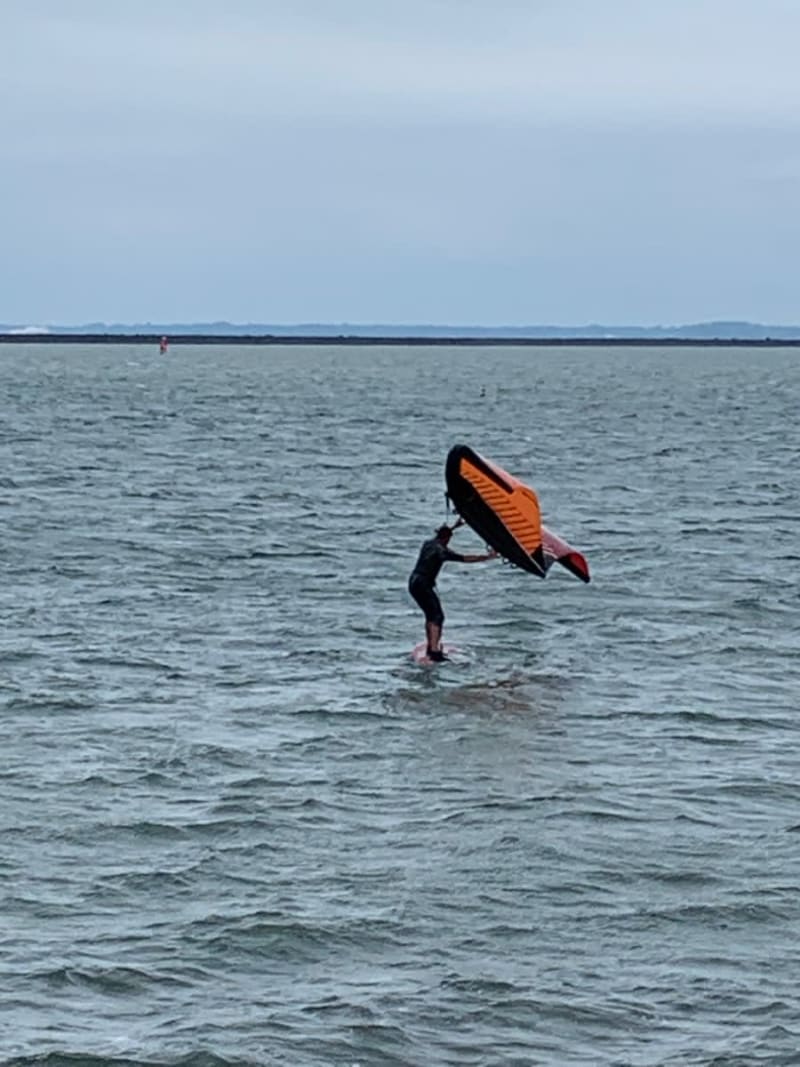
The arc of progression at a single spot is something I don't think gets talked about enough. Year one at Gallagher was purely about staying on foil — touching down, getting back up, staying upwind enough to not swim in from the pier. Year two was about making upwind runs intentional rather than accidental. Year three was about getting jibes to stop being terrifying. By year four, they'd become something I actually look forward to — consistent enough in the harbor chop that I'm now setting my sights on tacks, which is the next real challenge on the progression ladder.
That wingfoil progression on Lake Erie happened at one spot, and that's not a coincidence. Returning to the same water teaches you things that no new spot can replicate. I know exactly how the chop builds in the afternoon when the thermal kicks in. I know where the gusts accelerate as they come over the grain elevator. I know how the harbor mouth affects the wind angle when the direction clocks slightly south of southwest. That knowledge lives in my body now, not in my head.
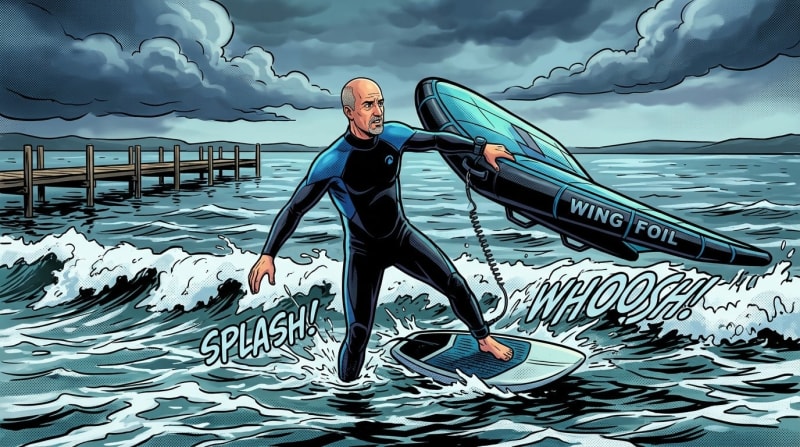
The current setup — a teal foil board and mast assembly rigged for Erie's conditions — is built for this environment. A mid-aspect front wing handles the variable chop well enough for harbor riding while still having the glide to push out into open lake when conditions are right. Erie doesn't need a race foil; it needs something forgiving and versatile.
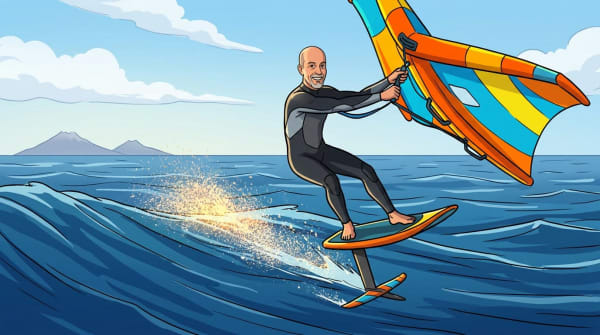
And then there are the moments every foiler knows: the orange wing, the shallow water, the wipeout, the reset, the long paddle back in. Those moments aren't failures. They're the cost of admission, and Gallagher has given me hundreds of them. But here's the thing — I've never paddled back in alone. There's always someone on shore who saw it, who's been there, who's already thinking about what they'd do differently. Progression is not a solo achievement. It happens in community, watching others, trading tips on the boardwalk, sharing the space.
The Gallagher Beach Tribe: Why the Wingfoil Community in Buffalo Makes You Better

The Gallagher Beach Tribe: Why the Wingfoil Community in Buffalo Makes You Better
I want to be direct about something: the spot is good, but the people are the real asset. The wingfoil and windsurf community at Gallagher Beach is the reason this place has an outsized effect on progression. Both sports share the launch zone, and the knowledge exchange between them is genuine and generous. Windsurfers have been riding this water for decades — some of them since before Erie wingfoil culture existed as a concept — and they know this lake better than any app or forecast model.
Picture two people in full wetsuits, O'Neill hoods pushed back, grinning at each other after a cold fall session. That's the wingfoil community in Buffalo. That's what shows up at Gallagher on a 50-degree October afternoon when the wind is perfect and the harbor is empty. Those are the people who will tell you where the gusts are hiding, which forecast model runs hot for Erie, and whether the session you're about to miss is worth waiting for.
Showing up as a newcomer at Gallagher is not an audition. The vibe is welcoming in a way that feels earned rather than performed. Gear gets discussed freely — what's working, what isn't, what someone is testing for the first time. The windsurfers rigging green sails on the grass near the launch aren't a separate faction; they're the institutional memory of this spot, and tapping into that knowledge base is one of the smartest things a new foiler can do.
Newcomers aren't welcomed as outsiders trying to break in. They're welcomed as members who haven't arrived yet.
Practical Guide: How to Launch at Gallagher Beach, Where to Park, and What to Bring
Practical Guide: How to Launch at Gallagher Beach, Where to Park, and What to Bring
Here's the logistical breakdown, because knowing a spot exists is only half of it.
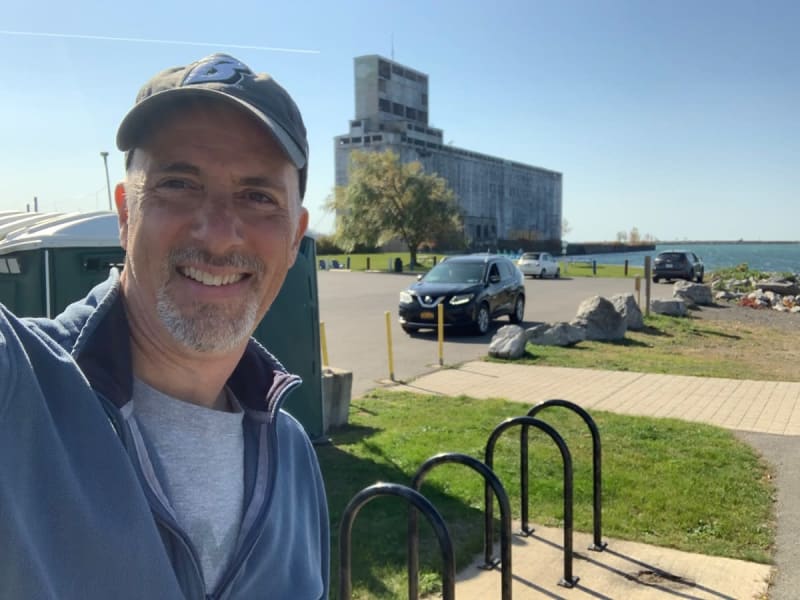
Parking: The Outer Harbor lot near the grain elevator is your target. It's well-marked, free, and close enough to the launch area that you're not hiking gear across a parking lot in a full wetsuit. The paved path from the lot to the water is foil-board-friendly — no stairs, no deep sand, no drama.
Staging and rigging: The grass area near the bike racks is where everyone rigs up. There's room to spread out a wing and lay a foil board flat without being in anyone's way. Restrooms and basic facilities are on site, which matters more than people admit on long sessions.
The launch itself: The small beach and ramp area near the pier is your entry point. It's accessible for foil boards and wings without needing a formal boat launch — you can walk your board in, get your footing, and go. The water depth comes up gradually, which is forgiving for those first few meters before you're up on foil.
Wetsuit reality: Lake Erie water temps drop fast after September. A 4/3 with a hood covers the shoulder season comfortably. If you want to ride into November — and some people here do — add boots and gloves. The cold is manageable if you're dressed for it.
What doesn't work here: Strong north or east winds are sessions to sit out, full stop. Those directions push you directly toward the concrete pier, and there's no protected pocket to save you if something goes wrong. Check the forecast, check the turbines, and if it's not SW or W, come back tomorrow.
Why Your First Spot Matters More Than Your First Wing — The Best Spot to Learn Wingfoiling on the Great Lakes
Why Your First Spot Matters More Than Your First Wing — The Best Spot to Learn Wingfoiling on the Great Lakes
Every conversation about learning to wingfoil eventually becomes a gear conversation. Which wing size? Which board volume? Which foil aspect ratio? These are real questions, and the answers matter — but they're secondary to a question almost nobody asks first: where are you learning?
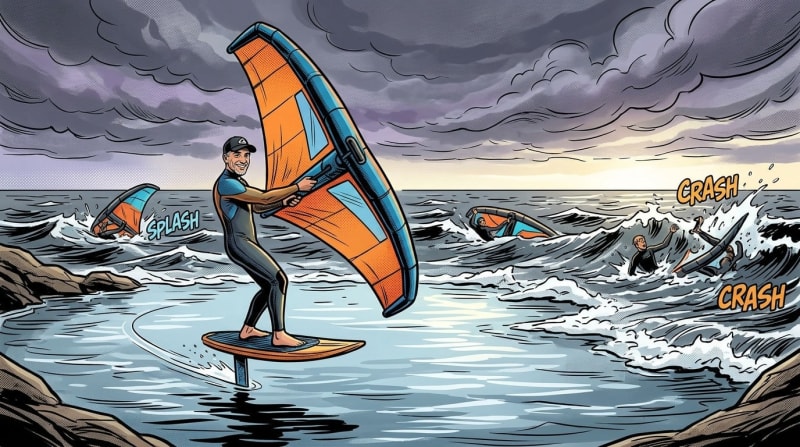
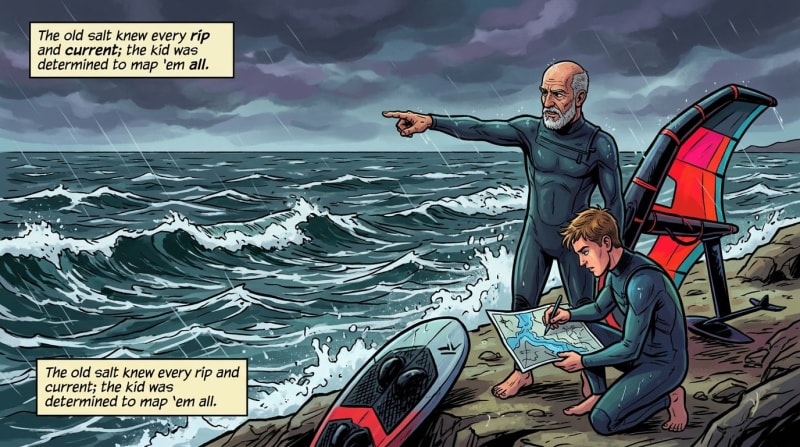
The best spot to learn wingfoiling on the Great Lakes isn't the one closest to you or the one with the biggest parking lot. It's the one with protected flat water, consistent wind, and a community that knows the conditions. The research on motor learning is clear on this: simplified environments during early skill acquisition stages allow the nervous system to build foundational movement patterns faster and more durably. Beginners who are fighting chaotic conditions aren't learning to foil — they're learning to survive. Those are different educations.
There are dozens of spots on Erie, Ontario, Huron, Michigan, and Superior. Some are exposed and punishing. Some are inconsistent. A few — and Gallagher is one of them — offer the environmental scaffolding that early progression actually requires. That's rare, and it's worth traveling for.
Why Gallagher Beach is one of the best kept secrets for learning to wingfoil on the Great Lakes isn't a mystery once you've ridden here. It's the breakwall, the flat water, the consistent SW and W windows, and the community that's been quietly building knowledge at this spot for years. Every region has a version of this place — a protected pocket that the broader wingfoil community hasn't fully discovered yet. Finding yours isn't just a personal win. It's a contribution to everyone who comes after you.
What's your local version of Gallagher Beach, and are you willing to share it?
If you're anywhere near Buffalo or planning a Great Lakes wing trip, put Gallagher Beach on your list. Show up on a southwest wind day, rig near the bike racks, and introduce yourself to whoever is already there. You'll learn more in one session — from the water, from the conditions, from the people — than you will from a month of forum research. And if you've already found your own secret flat-water pocket somewhere on the inland seas, drop it in the comments. This community gets better when we share what we know, and there are a lot of great sessions out there still waiting to be discovered.
Content ID: hQ1ZraEd1H5D7bmxy7PMuq5r
See an error? Tell us.
Comments
Share with the Community