
The Wing Foil Jibe Demystified: Why It Takes So Long (And How to Finally Get It)
The Short Version
- Most dedicated wing foilers with solid water time report taking 6 to 18 months to land consistent jibes — and that timeline has nothing to do with fitness, coordination, or commitment.
- The crash you're blaming on the foot switch is almost never a foot switch problem — it's usually a bad carve entry that left you with too little speed and no wing power before you ever got there.
- Toe-to-heel transitions are structurally different in feel, with more restricted vision through the turn and a fully mirrored wing flip sequence, yet most riders barely practice that direction at all.
- Isolating drills — like flipping the wing while riding straight, or carving downwind without attempting the flip — builds motor patterns faster than grinding full attempts that fail in a different spot every time.
- Gear choices have real consequences for skill acquisition: a larger front wing buys glide time through the turn, a taller mast gives correction margin before a breach, and a bigger wing means faster power recovery after the flip.
The wing foil jibe is one of those moves that will humble you for months — sometimes years — and if you're stuck in the middle of that grind right now, this breakdown of the mechanics, the timeline, and the real fixes is exactly what I wish had existed when I started. There's a particular kind of frustration that comes with a move you know you should be landing by now, and most of the content out there doesn't help because it skips straight to the step-by-step without ever explaining why the thing is so brutally hard in the first place. This piece does both. Whether you're throwing your first attempts or you've been close for six months and can't quite close it out, you're in the right place — and you're in very good company.
Why the Wing Foil Jibe Is the Hardest Fundamental Move You'll Learn
Why the Wing Foil Jibe Is the Hardest Fundamental Move You'll Learn
The wing foiling learning curve has a few genuinely nasty checkpoints, and the jibe is the nastiest. What makes it uniquely demanding isn't any single element — it's the compression. In the span of a few seconds, you're managing foil pitch control to stay on the water through a downwind arc, timing a wing flip that has to land at exactly the right moment, and switching your feet, all while the board is rotating underneath you and your speed is fluctuating. Tacks are hard too, but they happen at higher speeds and give you a narrower window. The jibe demands precision at pace.
Most dedicated riders with solid water time report taking somewhere between 6 and 18 months to land consistent jibes — and I want to sit with that number for a second, because "consistent" is a high bar. We're not talking about the one magic attempt on a glassy Tuesday. We're talking about a move you can call on in varied conditions, on both tacks, session after session. That kind of consistency takes time, and it's not a reflection of your fitness, your coordination, or your commitment. It's the nature of the move.
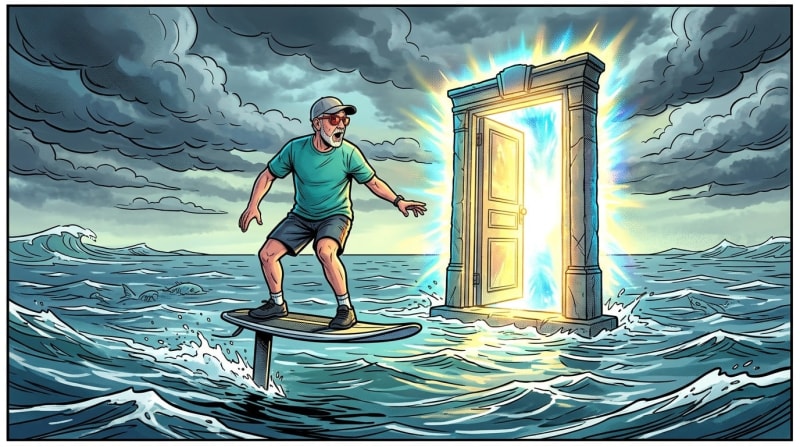
Here's the reframe that helped me most: the jibe isn't a wall you keep running into. It's a door. A heavy door with a stiff handle, sure — but once it swings open, everything changes. Your downwinders get faster. Your confidence in powered conditions jumps. Your whole relationship with the foil deepens. The grind is real, but so is what's on the other side of it.
Most online content skips the why it's hard part and jumps straight to the steps. We're not doing that here.
Breaking Down the Heel-to-Toe Jibe Mechanics Step by Step
Breaking Down the Heel-to-Toe Jibe Mechanics Step by Step
The heel-to-toe transition is where most riders start, and for good reason — it's the more approachable entry point for the majority of stances. Understanding the heel-to-toe jibe mechanics in detail is what separates the riders who eventually land it from the ones who keep repeating the same crash in the same spot.
Setting Up the Carve
It starts well before the turn itself. You want to initiate the downwind carve from mid-mast height — not maxed out, not dragging the board, but riding at a foil height that gives you margin to work with in both directions. Coming in too high is one of the most common setup errors because it feels fast and confident, but it leaves you no room to compensate when the foil pitches in the turn.
As you begin the carve, drive pressure through your front foot. This is the physical cue that tells you everything is on track — if you can't feel that front foot loading, you're likely sitting back and about to stall. The wing should move toward neutral during the carve itself. You're not trying to generate power at this moment; you're managing the arc. Let the momentum you built on the reach do the work.
The Wing Flip and Foot Switch
The wing flip timing is where most jibes die. The most common breakdown is initiating the flip too early — before the board has completed enough of its rotation through the gybe arc — which kills your momentum and leaves you with a stationary foil and no power to exit on. The other failure mode is flipping too late and having to muscle the wing around after you've already slowed to a crawl.
The cue to look for is what I think of as the "pause" moment — that brief window just past the deepest downwind point of the turn where the board has swung through and is beginning to track onto the new tack. That is your flip window. It's not at the start of the carve, and it's not after you've stabilized. It's right there in the middle of the motion.
After the flip, the foot switch follows once the wing is loaded and pulling again. Rushing the stance change before you have drive from the wing is one of the three most reliable ways to end up in the water — more on that in the mistakes section.
Where in this sequence are you getting stuck? Drop it in the comments — this community learns faster when we're honest about the specific breakdown points, not just the general feeling of it going wrong.
Toe-to-Heel Transitions: The Direction Most Riders Ignore

Toe-to-Heel Transitions: The Direction Most Riders Ignore
Here's something that doesn't get said enough about the toe-to-heel wing foil transition: most riders barely practice it. We all have a dominant side, and when jibes are already hard, the natural instinct is to grind the direction that at least feels possible and hope that improvement somehow transfers. It doesn't — or at least not fast enough.
The mechanics of the toe-to-heel direction are genuinely different in feel. The carve feels less natural for most riders because you're pushing onto your toe edge through the turn rather than sinking into your heel-side hip, which is the more intuitive motion for most body types. Your vision through the turn is also more restricted — you're looking over your front shoulder rather than opening your body toward the exit, which means you lose visual reference points at the exact moment you need them most. And the wing flip sequence is mirrored, so the hand and arm coordination that you've been drilling on your good side doesn't simply transfer — you're essentially relearning the timing from scratch.
Kiteboarders and windsurfers know this problem intimately. The carve gybe in windsurfing has the same asymmetry built in, and every windsurfing coach worth listening to will tell you that deliberate practice on the weak side is non-negotiable. This isn't a wing foiling quirk — it's a structural feature of rotational transitions in board sports.
The riders I've seen unlock jibes fastest are almost always the ones who committed equal session time to both directions early. What they develop isn't just muscle memory — it's a more complete mental model of what the move actually is, because when you have to learn it from scratch on your weak side, you can't coast on habit. You have to think it through again. And that thinking-through is what builds the understanding that makes both sides eventually click.
The Most Common Jibe Mistakes and What's Actually Causing Them
The Most Common Jibe Mistakes and What's Actually Causing Them
This is where I want to be genuinely useful rather than vague, because most common wing foil jibe mistakes come with a specific cause — and the symptom and the cause are often happening at different moments in the sequence, which is why people keep fixing the wrong thing.
1. Foil breach mid-turn. You're entering too fast or too high. The fix isn't in the turn — it's in your setup. Slow down before the initiation and drop a few inches of foil height Before you start the carve.
2. Stalling out of the turn. You're losing your downwind angle too early, essentially trying to come onto the new tack before the wing flip is complete. The fix is to commit deeper into the downwind arc and trust that the foil will stay under you long enough to let the flip happen.
3. Crashing on the foot switch. This feels like a foot switch problem, and almost every rider diagnoses it as one. It usually isn't. A crash on the foot switch is most often caused by a bad carve entry — you arrived at the foot switch moment with too little speed, no wing power, or both, because the carve itself was compromised. Fix the entry, and the foot switch often fixes itself.
One of the most underrated tools for diagnosing which moment is actually breaking down: phone video from a beach angle. Even shaky handheld footage reveals things you genuinely cannot feel in real time. The body does things under pressure that it doesn't report accurately back to your brain — seeing it from the outside changes everything.
Training Drills That Actually Accelerate Your Jibe Progress

Training Drills That Actually Accelerate Your Jibe Progress
Wing foil jibe drills only work if they're isolating the right thing, and most riders don't isolate enough. They try the full move over and over, fail in a slightly different place each time, and call it practice. It's not — it's just repetition without information.
Here are three specific drills worth your session time:
Downwind carve without the flip. Just carve, ride out downwind, and repeat. You're not trying to jibe — you're grooving the foil arc, building confidence in your downwind angle, and training that front-foot pressure cue until it's automatic. You'd be surprised how many jibe problems live here.
Wing flip drills on flat water while riding straight. Park the carve entirely and just practice the hand sequence — from one tack grip to neutral to the opposite grip — while rolling in a straight line. Isolating the flip timing in a zero-stakes environment builds the motor pattern faster than embedded practice during a full attempt.
Slow-speed jibes in light wind. This one is underrated across the board. Less power means more time in each phase of the move, which extends the learning window significantly. Light-wind sessions are not consolation prizes — they're the best jibe classroom you have access to.
Flat water is your friend for all of this. If you're on the East Coast, that means hunting down your protected bay window before the afternoon sea breeze fills in. If you're in the Med, you know those glassy morning hours are gold. Wherever you are, find your local flat-water window and treat it like scheduled practice, not just a bonus session.
These drills aren't punishment. They're a gift you give your future self. The riders who nail jibes fastest are almost universally the ones who made peace with boring repetition on calm days.
Real-World Timelines: How Long Should the Wing Foil Jibe Actually Take?
Real-World Timelines: How Long Should the Wing Foil Jibe Actually Take?
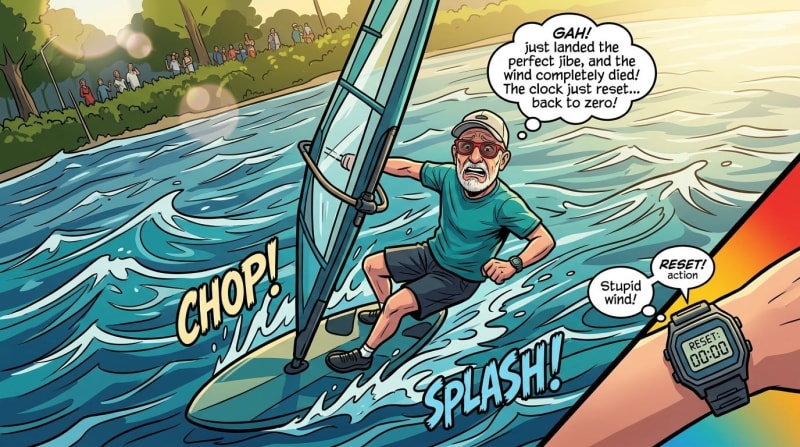
Let's be straight about how long to learn the wing foil jibe, because the range the community reports is wide and the social media version of events is deeply misleading.
Casual riders — one or two sessions a week, variable conditions — often report taking two years or more to reach anything resembling consistency. Dedicated riders with frequent water time, deliberate practice, and some coaching often see their first consistent jibes in the 6–12 month range. And both of those timelines are completely normal.
"Consistent" is doing a lot of work in that sentence, though. Landing one jibe on a glassy day in 12 knots is a milestone worth celebrating, but it's a long way from landing jibes in chop, in 20 knots, or on your weak tack. The progression continues well past the first landing.
Context helps here: the carve gybe in windsurfing is one of the most notoriously difficult fundamentals to automate in any board sport, despite windsurfers having been refining instruction for it for decades. The difficulty isn't a teaching failure — it's structural to the physics of rotating a planing or foiling craft through a downwind arc while managing power and stance simultaneously. Wing foiling adds the foil element on top of that. The challenge is real.
And those clips you're watching where someone threads a perfect jibe in powered onshore chop? That's the one-in-ten attempt, not the session average. Even experienced riders miss jibes regularly. The difference is they've accepted that as part of the sport rather than evidence of inadequacy.
You are not behind. You are exactly where this move puts people.
Gear Setup Considerations That Make the Jibe Easier to Learn
Gear Setup Considerations That Make the Jibe Easier to Learn
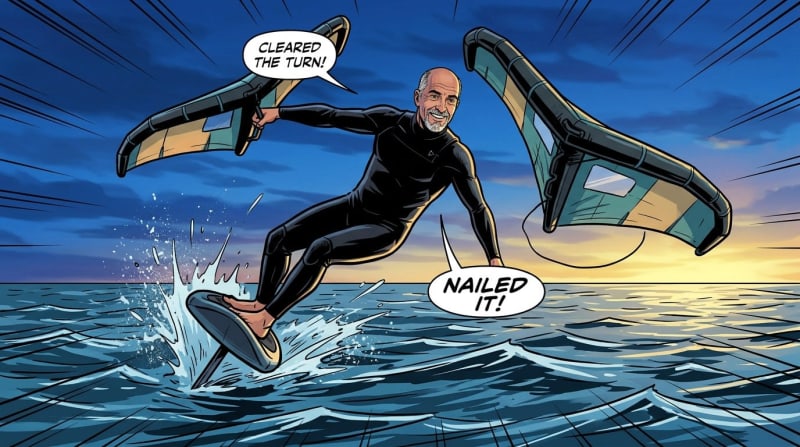
I want to be clear upfront: this section isn't a recommendation to go buy new equipment. It's about understanding what your current wing foil gear setup for jibes is asking of you — because sometimes the gear is making an already hard move harder, and knowing that matters.
Front wing surface area. A larger front wing gives you more glide through the turn and more margin to complete the move before the foil loses lift and you sink. If you're riding a high-aspect, lower-surface race wing and struggling with jibes, that wing is working against your learning — not because it's a bad wing, but because high-aspect foils are less forgiving of the speed variations that happen mid-turn. A larger, more moderate front wing buys you time.
Mast length. A taller mast gives you significantly more margin than a shorter one when things go sideways in the middle of a turn — and things will go sideways. You have more distance between the board and the water's surface, which means more room to correct before you touchout or breach. Riding a taller mast during the jibe-learning phase is a legitimate strategy that a lot of experienced coaches recommend, and it's not cheating. It's smart.
Wing size. A slightly larger wing than you'd normally choose for the given conditions means you can re-engage power faster after the flip. That faster power recovery is what helps you nail the exit rather than limping out of the turn with a half-loaded wing and no drive.
Board shape. Wider, more stable platforms with moderate rocker are genuinely more forgiving through the foot switch than narrow, high-performance shapes. This doesn't mean you need a beginner board forever — it means that if you're already on a challenging platform, your learning curve for this specific move will be steeper.
None of this is about gear as a shortcut. It's about being honest with yourself that equipment choices have real consequences for skill acquisition, and setting your current gear up to work with you rather than against you.
The wing foil jibe is the move that separates the people who ride from the people who really fly — and the distance between those two things is a matter of time, honest practice, and being willing to look clearly at what's actually breaking down in the sequence rather than what feels like it's breaking down. If you're deep in the grind of learning it right now, drop a comment below and tell me exactly where in the sequence you're getting stuck — the setup, the carve, the flip timing, the foot switch, or something else entirely. I'd genuinely rather we figure this out together than have you white-knuckle it alone through another season of close calls.
Content ID: Dmtn5Cbm1P5emB6TBUguGaiO
See an error? Tell us.
Comments
Share with the Community