
Wing Foil Front Wing Selection Guide: How to Pick the Right Foil for Your Conditions
The Short Version
- The front wing accounts for roughly 75% of ride feel — upgrading your foil will change your experience more than any new sail or board.
- Going too small too fast is the most reliable way to plateau: undersized foils punish every technique gap and leave no margin to develop.
- Mid-aspect ratio foils (AR 5–7) deliver the best return for intermediate riders — wide enough power band to be forgiving, efficient enough to deliver satisfying glide.
- Two carefully selected foils (a 1100–1400cm² light-wind wing and an 850–1000cm² all-around) cover 90% of typical sessions better than five foils chosen without a framework.
- Minimum foiling wind speed scales directly with area: a 1400cm² wing gets you up at 8 knots, while a 600cm² wing demands 18 knots of consistent wind.
- Match front wing area to your actual local wind conditions first, then refine by rider weight — those two inputs outperform any gear review.
There's a moment most intermediate wing foilers hit. You've been flying the same setup for months — getting up consistently, riding downwind, starting to link turns. But something feels stuck. The foil doesn't respond the way you want. Light-wind sessions feel like wrestling. pumping back up feels like labor. You assume it's your technique, or maybe you need a bigger sail. Then you try someone else's front wing — and the whole sport resets.
That shift is almost always the front wing. Getting wing foil front wing selection right doesn't require more gear or more water time. It requires understanding what the numbers mean and how they match to the conditions you actually sail in.
Why Front Wing Choice Matters More Than Board or Wing
Why Front Wing Choice Matters More Than Board or Wing
The front wing is the lift-generating engine of your entire setup. Board shape affects stability on takeoff. Mast length changes feel in chop. Tail wing adjusts pitch character. But the front wing — its area, its shape, its aspect ratio — determines when you get on foil, how fast you cruise, how hard you work to stay there, and what your ceiling is for conditions.
Most intermediate riders upgrade their inflatable wing (sail) first. It makes intuitive sense: the sail is what you're holding, it's visible, and sail upgrades are well-marketed. But the foil is what carries you. A more powerful 6m sail on an undersized foil still won't get you up in 10 knots. A well-matched foil on a modest sail will.
According to foil coaches at AWSI-certified instruction programs, the front wing accounts for roughly 70–80% of what riders describe as "ride feel." Everything else layers on top of that foundation.
That's not an argument to ignore your sail or your board. It's an argument to prioritize front wing selection when you're trying to figure out why your riding feels stuck.
Surface Area: The Number That Determines Your Wind Range
Surface Area: The Number That Determines Your Wind Range
Surface area is measured in square centimeters and it is the most useful single number when evaluating a front wing. More area means more lift at lower speeds — earlier takeoff, more forgiving of inconsistent pump, ability to foil in lighter wind. Less area means less drag, higher top speed, and better control in strong conditions.
That tradeoff is real and non-negotiable. The general size categories that Axis Foils, Cabrinha, Slingshot Sports, and most major brands converge on:
- 1200–1500cm² — Light wind and learning range. Generous lift, early takeoff, forgiving of inconsistent pump. Minimum viable wind: 8–10 knots for an intermediate rider.
- 900–1100cm² — The progressing zone. Most intermediate riders' primary foil. Gets you up at 11–14 knots with decent technique, comfortable to around 22–24 knots before it feels overpowered.
- 600–850cm² — Speed and high-wind territory. Demands committed technique and consistent speed management.
The minimum foiling wind speed by area, validated across manufacturer specs and instructor documentation:
The mistake most riders make is not going too big — it's going too small too fast. You see an advanced rider on a 750cm² foil carving clean turns in 15 knots and you want that. What you don't see is the two seasons of technique that make a small foil workable. On an undersized wing, any lapse in pump efficiency, any slow gybe, any brief speed loss means you're back in the water. The margin for error compresses dramatically as area shrinks.
The Foiling Magazine has documented this pattern consistently in rider profiles: premature downsizing is one of the most reliable sources of intermediate-level plateau.
If most of your sessions happen in 12–18 knots and you're still building consistent turns — what does your current foil ask of you that it shouldn't? That question is worth sitting with before you click buy on anything smaller.
Aspect Ratio: What High vs Mid vs Low Actually Means on the Water
Aspect Ratio: What High vs Mid vs Low Actually Means on the Water
Aspect ratio (AR) is the relationship between a wing's span and its area. The formula: AR = span² ÷ area. A long, narrow wing has a high aspect ratio. A shorter, wider-chord wing has a low aspect ratio.
What that means on the water:
High aspect (AR 7+): These foils glide. Pump once and they carry you a remarkable distance. The tradeoff is a narrower power band — the speed window where they feel comfortable is tighter. Go too slow and they stall abruptly. The pitch sensitivity that makes them efficient also makes them reactive, and technique gaps get amplified rather than hidden.
Mid aspect (AR 5–7): The category most serious intermediate riders should live in. Wider power band, more tolerant of speed variation, still efficient enough to glide well between pumps. You can recover from a near-stall without the high-stakes response that a high-AR foil demands. Top speed is lower, but you spend more time actually foiling rather than recovering from stalls.
Low aspect (AR below 5): Maximum lift, maximum pump ability, maximum forgiveness — with a hard ceiling on speed and upwind angle. These wings excel in surf and chop where maneuvering matters more than efficiency. Many freeriders stay here permanently because the ride character suits them.
The practical difference in glide performance across these categories is significant:
According to wingfoildaily.com, high aspect ratio foils require meaningfully more refined technique — particularly at lower speeds and during transitions — before they deliver their advertised performance. Most intermediate riders who try a high-AR foil for the first time describe it as unpredictable, not because the foil is flawed, but because their technique hasn't yet learned to read its feedback.
The mid-aspect sweet spot — roughly AR 5.5 to 6.5 — is where intermediate riders consistently get the best return on water time. Brands anchor their all-around product lines in this range for exactly that reason.
Matching Your Front Wing to Your Conditions
Matching Your Front Wing to Your Conditions
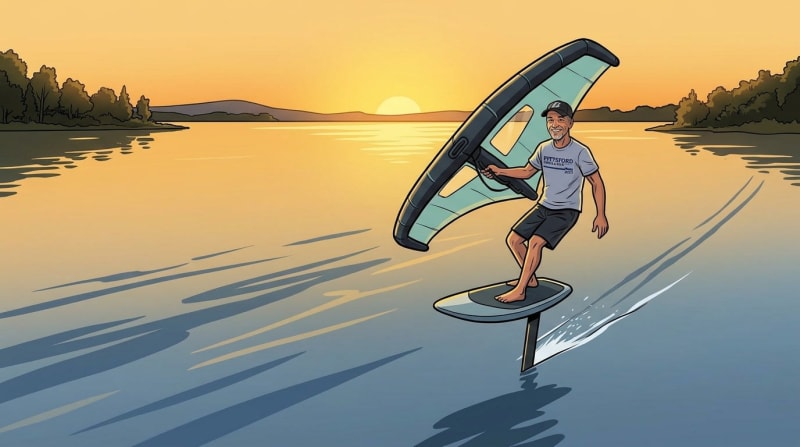
Foil selection isn't only about skill level — it's about the specific water you're actually on. Two riders at the same level in different environments may need meaningfully different setups.
Lake versus ocean. Lake sessions typically offer flatter water and steadier wind, which favors higher-aspect foils. Chop is minimal, so the foil's pitch sensitivity becomes a feature rather than a threat. Ocean sessions, even in moderate conditions, introduce constant bump and chop. A 6.2 AR foil that feels perfect on a flat lake may feel nervous and reactive in the same wind speed offshore.
Wind band matching. The cleaner heuristic for most riders: match your front wing area to the wind window you're targeting:
These are starting points — rider weight matters significantly. Heavier riders need more area to achieve equivalent lift at equivalent speed. A 185-pound rider in 14 knots may need 1100–1200cm² where a 140-pound rider manages on 950cm².
Light wind (8–14 knots): More area, lower aspect, maximum pump ability. A 1200–1400cm² low-to-mid-aspect wing earns its keep here. You need to generate your own speed through pumping because the wind alone won't sustain you.
Moderate conditions (15–22 knots): The sweet spot for most quivers. A 900–1100cm² mid-aspect wing covers this range cleanly — enough wind to stay up through lulls without relying entirely on pump.
Strong conditions (22+ knots): Smaller area for control. A large foil in 25 knots creates excess lift that becomes difficult to manage. Moving to 700–850cm² gives you the damping that keeps things manageable at speed.
What are the actual wind conditions you sail in 75% of your sessions, and what rider weight are you bringing to those conditions? Those two inputs tell you more about which front wing to buy than any gear review.
The Two-Foil Quiver That Covers 90% of Conditions
There's a gear acquisition pattern the wing foiling community talks about constantly. You start with one foil, realize it doesn't cover your lightest-wind days, buy a bigger one, realize it's too big when the wind picks up, buy a medium, and suddenly you have three foils with none of them quite right. More gear purchased as a substitute for clearer thinking.
Two carefully chosen foils — bought with a clear framework for your local conditions — will cover 90% of your sessions better than five accumulated without a plan.
The combination that works for most intermediate riders across the wing foil intermediate gear range:
Foil 1 — The light-wind workhorse: A 1100–1400cm² mid-aspect wing. Your go-to for anything under 15 knots, your pump-back-to-the-beach foil, your "the wind is marginal but I'm going anyway" foil. It should be the most forgiving, most predictable wing in your bag.
Foil 2 — The all-around: An 850–1000cm² mid-to-high-aspect wing. This is what you reach for when the wind is real — when you want to push technique, ride upwind, or work on transitions. The smaller area keeps it tractable at 20+ knots without getting overpowered.
Together, these two foils cover 8 knots to 28+ knots across a range of conditions. The overlap zone — roughly 14–18 knots — is where you get to choose which ride you want: the floaty, forgiving one or the snappy, technical one.
"The foil that gets you out more often is always better than the foil that sits in the bag waiting for perfect conditions."
When is it time to add a third? When you've spent at least a season on your two-wing quiver, you know exactly what each one does, and you can articulate what is still missing — not "I want something different," but "I have a specific condition where neither foil gives me what I need, and I'm in those conditions often enough to justify it." That clarity is the only trigger worth acting on.
The wing foiling community is genuinely generous with gear knowledge. At nearly every session, someone will let you try their setup if you ask. Find the rider who is two seasons ahead of you and ask what they would change about their gear progression. That kind of sharing — experience given freely, no sales pitch attached — is one of the things that makes this sport worth showing up for.
What's waiting when you find the right front wing isn't just better performance. It's the feeling of riding with your equipment instead of against it.
Content ID: SV3yfQZ4HnXg14UF6jgTKAKl
See an error? Tell us.
Comments
Share with the Community