Your First Full Season of Wing Foiling: What to Realistically Expect and How to Progress Faster
The Short Version
- Most adults need roughly 25 sessions before they can ride comfortably in both directions — not the 3-session highlight reel the internet keeps showing you.
- Sessions 7 through 12 are where the majority of beginners quietly stop showing up, and that's exactly when the nervous system is on the verge of consolidating real skill.
- Looking at the board instead of the horizon is one of the most common brakes on progress — fixing your gaze on the horizon reportedly doubled session length within two days.
- Board volume matters more than ego: instructors consistently recommend 110–140L minimum for most adults, and 160L is not excessive if you're on the heavier side.
- The plateau that feels like regression is actually a reorganization phase, and the most useful thing during it isn't new gear or new information — it's people who have been through it telling you to come back tomorrow.
It Started Behind a Boat

It Started Behind a Boat
I didn't start the way most people start. There was no lesson on the beach, no YouTube progression checklist, no carefully chosen beginner conditions. In August 2021, someone put me behind a boat and essentially towed me into my first experience with a wing.
That's one way to do it. The boat pull gives you something you can't manufacture on your own in those first sessions — speed. Without having to generate power through the wing, you get to feel what it's like to have a board moving under you fast enough that the foil actually wants to lift. For maybe thirty seconds at a time, something clicked. Then it didn't. Then it did again. By the time I got to Gallagher Beach in Buffalo for my first real sessions on my own, I had some muscle memory of what liftoff felt like — even if I couldn't reproduce it consistently.
What I didn't have was any realistic picture of what the season ahead would actually look like. Nobody tells you the true timeline before you start. The forums are full of people who got up in three sessions and people who are still grinding after thirty, and no one is very honest about which category most adults actually fall into.
This is what I wish someone had told me before that first August session.
The Real Timeline Nobody Shows You

The Real Timeline Nobody Shows You
The internet compresses the learning curve because the people posting videos are the ones who figured it out. You don't see the twenty sessions of frustration that preceded the smooth run. You don't see the person who quit at session eight because they didn't know that session nine is often where something shifts.
Here is an honest map of what the first season actually looks like for most adult beginners starting from scratch — no kite, no windsurf, no foil background.
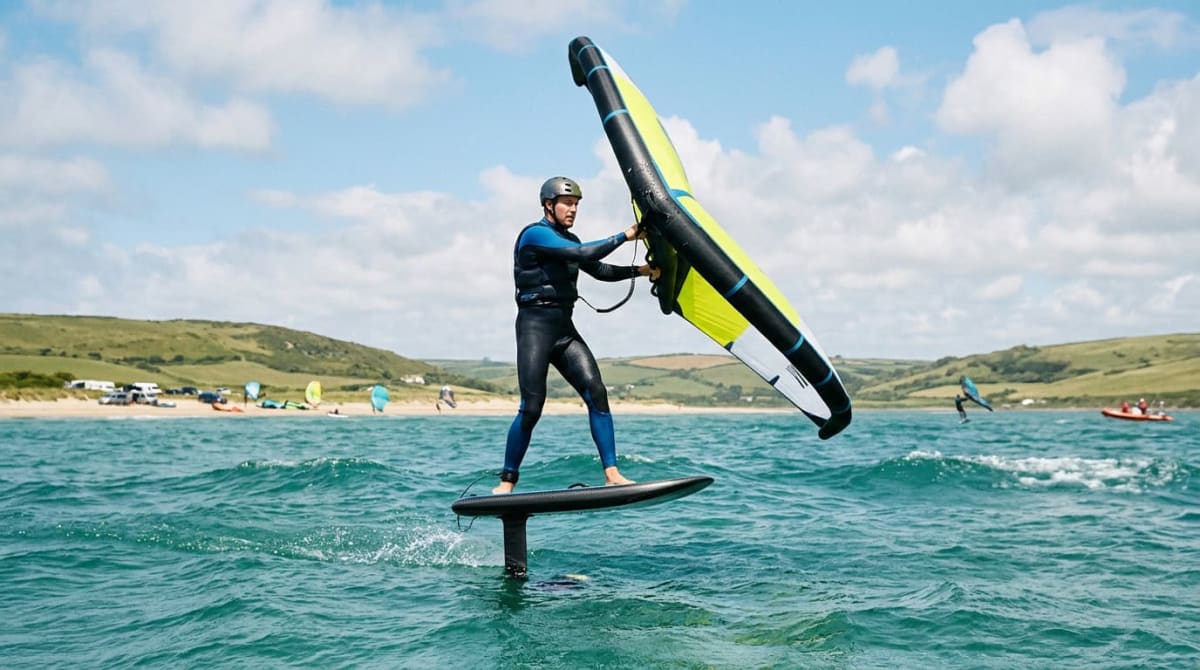
Sessions 1–3: Survival mode. You are learning what the wing does, how to hold it without your arms burning, and how to get the board pointed in a direction you intended. You will not fly. This is not failure — this is the foundation. The wing is a live animal in your hands, and domesticating it takes time. Getting comfortable generating power, spilling power, and repositioning without panicking is more important than any trick you'll ever learn.
Sessions 4–6: The first liftoff window. This is where most people get their first real taste — a few seconds off the water, followed immediately by a swim. The 6-second crash is a rite of passage, not a setback. As I've written before, your nervous system is logging every millisecond of that cartwheel even while your conscious mind is completely overwhelmed. The crash is your first real data point.
Sessions 7–12: The grind. This is the hardest stretch, and it's where most people either push through or quietly stop coming to the beach. Flights are getting longer but still unpredictable. You're staying on foil for 10 seconds, then 20, then losing it again. Progress feels nonlinear because it is — the nervous system doesn't improve in a straight line. It loads, stalls, then suddenly consolidates overnight. Sessions during this window can feel like going backwards. They're not.
Sessions 13–20: Things start to stick. Upwind control becomes intentional rather than accidental. You start finishing runs where you intended to finish them. The wing and the foil stop feeling like two separate problems you're managing simultaneously and start feeling like one system you're beginning to understand.
End of first season: For most adults on the Great Lakes, a full first season runs from May — when the water is still cold enough to require a heavy wetsuit despite warm air temperatures — through early November, when the lake's stored summer heat lets you keep riding even as air temps drop into the 50s. That's roughly six months of possible sessions, which is more runway than most beginners realize they have. By the end of it, you are staying on foil reliably, making upwind runs with intention, and have a feel for the equipment that no amount of watching videos could have given you. You are not doing jibes. You are not riding switch. You are flying, and you are building the hours that everything else will sit on.
The Plateau Nobody Warns You About

The Plateau Nobody Warns You About
There is a specific moment in the early sessions — usually somewhere between session four and session eight — where progress feels like it has stopped completely. You were getting better. Then one day you go out and it feels like you've forgotten everything. The board feels wrong. The wing feels wrong. You swim more than you flew last week. You start wondering if you're actually cut out for this.
This is not a sign you're not cut out for it. This is the plateau, and it happens to almost everyone.
What's actually happening is that your nervous system is reorganizing. The rough motor patterns you built in your first few sessions are being replaced by more refined ones, and during that transition, performance temporarily regresses. Sports scientists call this a consolidation phase. Coaches in every discipline know it as the moment that separates people who break through from people who don't.
The mistake people make at the plateau is changing something external — different gear, different spot, different conditions — when the actual work is internal and time-dependent. The plateau resolves through volume. More sessions. More water time. The body needs repetitions, not revelations.
What helps at the plateau isn't information — it's people. Having someone on shore who has been through it, who can watch your sessions and say "you're almost there, this is normal" is worth more than any video or article. This is why the community at Gallagher mattered so much in my first season. Nobody let me interpret a bad session as evidence that I couldn't do this. They just told me to come back tomorrow.
The Mistakes That Slow Everyone Down

The Mistakes That Slow Everyone Down
I made most of these. You'll probably make some of them too. Here's what they actually cost you.
Starting on too little board volume. The instinct to buy a board that looks like what the good riders use is almost universal and almost always wrong. Those riders are generating power and creating speed you cannot replicate yet. On a board that's undersized for your current skill level, you spend all your energy not falling off — which means you have nothing left to actually learn from. The consensus across instructors and experienced riders is consistent: 110–140L minimum for most adults, and if you're on the heavier side, 160L is not excessive. My Naish 140L inflatable was the right call on volume, even if I'd tell you now to skip the inflatable and go hard board from the start — inflatables are too soft underfoot to give you the feedback your nervous system needs.
Chasing conditions that are too challenging. According to ION Club's instructors, the ideal learning wind for most adults is 17–20 knots — not 12 knots, because you don't have enough power to generate takeoff speed, and not 25 knots, because you're spending all your energy managing a wing that wants to launch you. Gusty, shifty conditions multiply every problem you're already dealing with. Gallagher's protected flat water inside the breakwall was not just comfortable — it was actually essential to my early progress. If you're fighting chop, you're not learning to foil. You're learning to survive, and those are genuinely different educations.
Looking down. This was my biggest unlock, and I covered it in detail in the First 6 Seconds piece: the moment I stopped watching the board and fixed my gaze on the horizon, my session length doubled within two days. Your body follows your eyes in foiling exactly the way it does in skiing, cycling, and surfing. Looking at the problem creates the problem.
Applying front foot pressure too early. Most beginners feel the board start to lift and immediately push down to control it — which drives the nose back toward the water. The counterintuitive correction is to let the lift build a half-beat longer than feels comfortable before engaging front foot pressure to level off. Your body will resist this. The foil wants to climb steeply; your job is to let it rise gradually and then level it, not to arrest the rise before it happens.
Going it alone. Every instructor-sourced resource agrees on this one: self-teaching from videos builds bad habits that take longer to correct than learning correctly from the start. You can't see what you're doing wrong from inside your own session. Someone on shore can see it in five seconds. Find your people before you hit the wall, not after.
What Getting It Actually Feels Like

What Getting It Actually Feels Like
I can't describe the click moment in advance. Every foiler I've compared notes with uses different words for it, and they're all right and all incomplete. It happens somewhere in the middle of a session, usually when you've stopped trying to make it happen — when you've let go of the checklist long enough for your body to actually fly.
For me it happened at Gallagher, on a southwest wind day, the grain elevator in the background, nobody in my line. I stopped thinking about front foot pressure and wing angle and mast position and I was just... on foil. Not for six seconds. For long enough that I had to make a decision about what to do next.
That's the milestone that changes everything. Not your first liftoff — that's a beginning. The first run where you're actually riding rather than just surviving. That's when you stop being someone who is trying to wing foil and become someone who wing foils.
Year two, the upwind runs get intentional. Year three, you start working on jibes — which are harder than they look and take most people the better part of a season to make reliable. Year four, if you're putting in consistent sessions, jibes start to click in conditions you would have avoided a year earlier. Tacks are the next frontier, and they're genuinely difficult — technically more demanding than jibes because you're turning into the wind rather than away from it. That's what's on my list for 2026.
The sport has a long runway. That's not a warning — it's an invitation. Every season, there's something new to work toward. And the community of people working toward it alongside you is, in my experience, one of the most generous and genuinely stoked groups of people you'll find at any beach.
What milestone are you working toward this season? Whether you're chasing your first liftoff or finally committing to that jibe you've been circling for months — come find us at the water. The tribe is there.
Content ID: amlkemFtbHvDKDAMumI9t0DO
See an error? Tell us.
Comments
Share with the Community