

How to Pack the WAKA Folding Wing Foil Board for Air Travel (100L Airline Bag First Look)
The Short Version
- The fully packed WAKA airline bag — board, Naish Jet HA 1400 foil set, and a deflated wing — came in at 48 pounds, just two pounds under the standard 50-pound airline limit.
- The WAKA Glide 99 folding design is what makes 100L of board volume fit inside standard airline luggage dimensions in the first place — a rigid board at that size simply doesn't have that option.
- Foil wings must go into their own padded blade bags before entering the main travel bag, because the outer bag handles external impacts while the blade bags handle the internal ones, and a leading-edge ding at altitude is one you'll ride around for the rest of the trip.
- Packing order is non-negotiable: board goes in first with the hull down, foil components line the sides, and the tightly rolled deflated wing fills the remaining cavity — trying any other sequence breaks the geometry.
- Buyers shopping the WAKA system need to know the airline bag is sold separately from the board, and the larger version is required at 100L — the standard bag won't fit the Glide 99.
- A $10 handheld luggage scale is the single most important accessory for this setup, because catching yourself at 51 pounds at home costs nothing, while catching it at the check-in counter can cost $100 or more.
I was genuinely skeptical when I ordered the WAKA folding wing foil board travel bag — could one bag actually hold a 100L board, a full foil set, and a wing without blowing past the airline's 50-pound weight limit? Spoiler: it's closer than you'd think, and I want to walk you through exactly how I packed it. Because if you've ever stood in your garage surrounded by a mast, two wing blades, a fuselage, a board, and an actual wing, staring at the wall like it owes you an answer — you already know this problem doesn't have an obvious solution. This is the breakdown I wish someone had written before my first foil trip.
Why I Went With the WAKA Glide 99 for Travel

Why I Went With the WAKA Glide 99 for Travel
The core appeal of any wing foil travel board is simple: you want to ride your own gear, dialed to your skill and style, not whatever rental quiver some shop has left after the season. The WAKA Glide 99 earns its place in that conversation because it folds — meaning it actually becomes a shape that fits inside luggage, which most boards flatly refuse to do. That alone changes the math.
At 100L, the Glide 99 sits at the upper end of the volume range most foilers in the 170–190 lb range would reach for when learning or progressing. It's not a niche competition shape — it's a real, functional board for real sessions. But 100L also means it pushes against the limits of the standard WAKA bag, which is why I ended up with the larger airline-specific version. More on that in a moment.
Here's the honest community-wide truth: traveling with foil gear is a logistical nightmare. The foil alone — mast, fuselage, front wing, stab — is four separate items before you've even looked at the board. Most people I know who travel to chase wind either ship gear ahead (expensive, stressful), rent on arrival (fine until the rental quiver is wrong for your level), or show up with a board bag the size of a sedan and pay freight oversize fees. The folding board genuinely breaks that pattern.
And the destination motivation is real. When you see those beach shots — glassy water, clean wind lines, somewhere worth a 6-hour flight — you stop asking whether it's worth the hassle and start asking how to make it work.
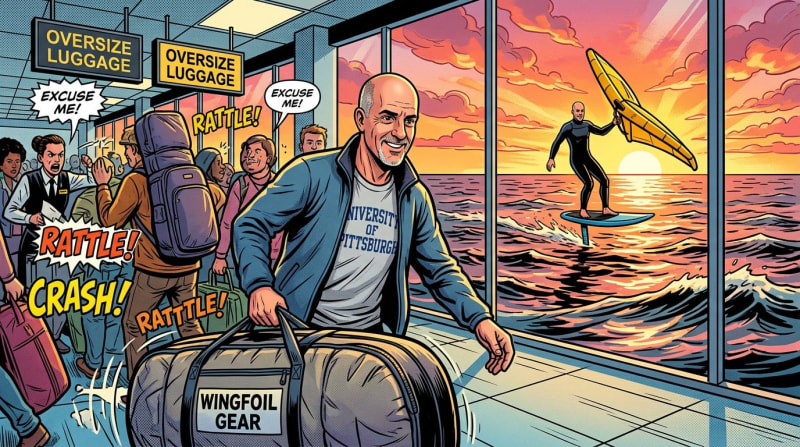
What Comes With the WAKA Airline Travel Bag
The WAKA airline bag is a purpose-built piece of kit, and it shows. The interior is padded and lined with silver insulation material — the kind that reflects heat and protects against tarmac abuse — and the whole thing rolls on a wheeled base with backpack straps for when you're navigating an airport that seems personally opposed to rolling luggage.
One detail that catches a lot of buyers off guard: the bag is sold separately from the board, and there's a size matrix in play. Smaller WAKA boards can use the standard travel bag. Once you're up at 100L, you need the larger airline bag. That's a meaningful purchase decision and not always obvious on the product page, so flag it for yourself before checkout.
Inside the main compartment, the Glide 99 goes into its own board sock — a fitted sleeve that ships with the board — before it ever touches the airline bag. Think of that sock as the board's first line of defense: it keeps the carbon hull and traction pad from grinding against foil hardware or zipper teeth during the kind of baggage handling that would make a grown adult wince.
The size matrix is worth understanding clearly. If your board is under roughly 90L, the standard WAKA bag likely fits. At or above 100L, budget for the upgrade. It's one of those details that feels minor until you're at the check-in counter with the wrong bag.
Packing the Board: Bottom Side Down, Foil Slots Facing Up
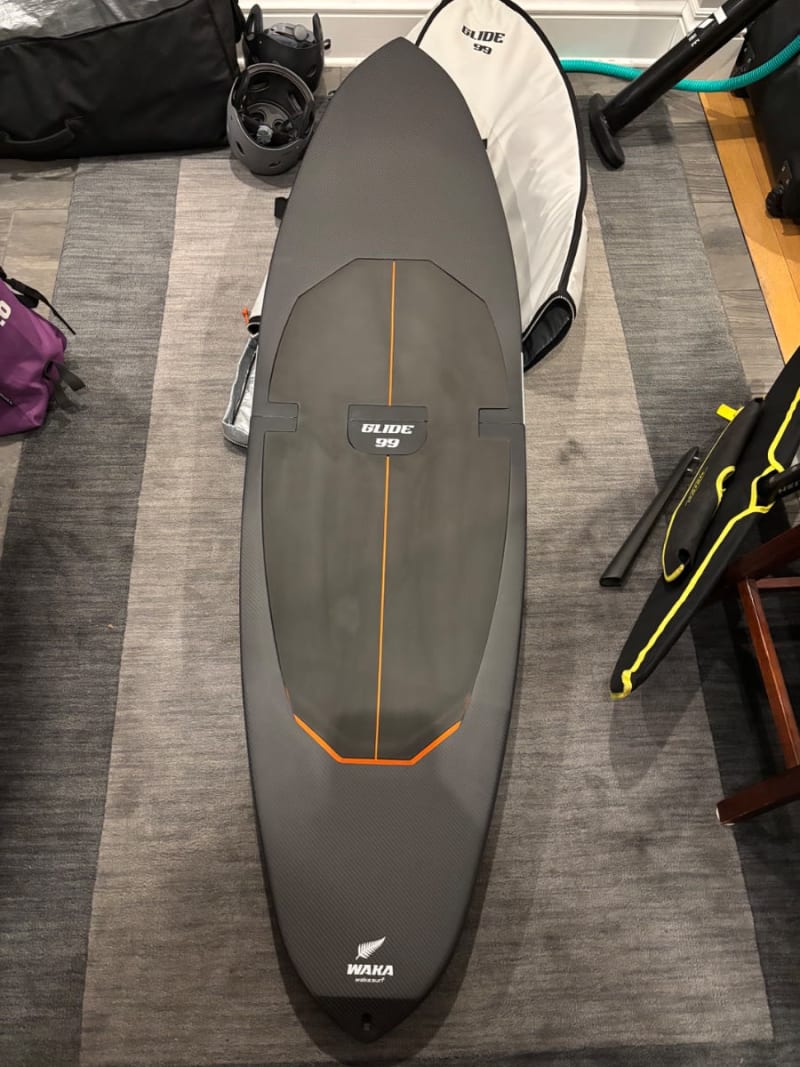
Packing the Board: Bottom Side Down, Foil Slots Facing Up
When packing a wing foil board this size, sequence matters more than force. The board goes in first — always — with the carbon hull facing down toward the bag's base and the deck (traction pad side) facing up. This distributes the board's weight against the reinforced bottom of the bag and keeps the traction pad from pressing into foil hardware.
The foil track slots in the Glide 99 run along the centerline of the board and, at 100L, fit inside the bag snugly but workably. You're not fighting the geometry — it's engineered for this — but you'll feel the difference between a bag that was designed for this board size and one that wasn't.
The board sock earns its keep here. Beyond protection, it acts almost like a low-friction sleeve, letting the board slide cleanly into the bag without micro-scratches on the hull edges. Carbon and zipper teeth are not friends.
One specific tip I'll pass along from painful experience: orient the nose of the board toward the wheeled end of the bag. It balances better when you're rolling through the terminal, and it keeps the tail — where most of the hardware stress concentrates — away from the impact end of the bag when it gets set down hard. And it will get set down hard.
Fitting the Foil: Naish Jet HA 1400 in Its Own Protective Cases
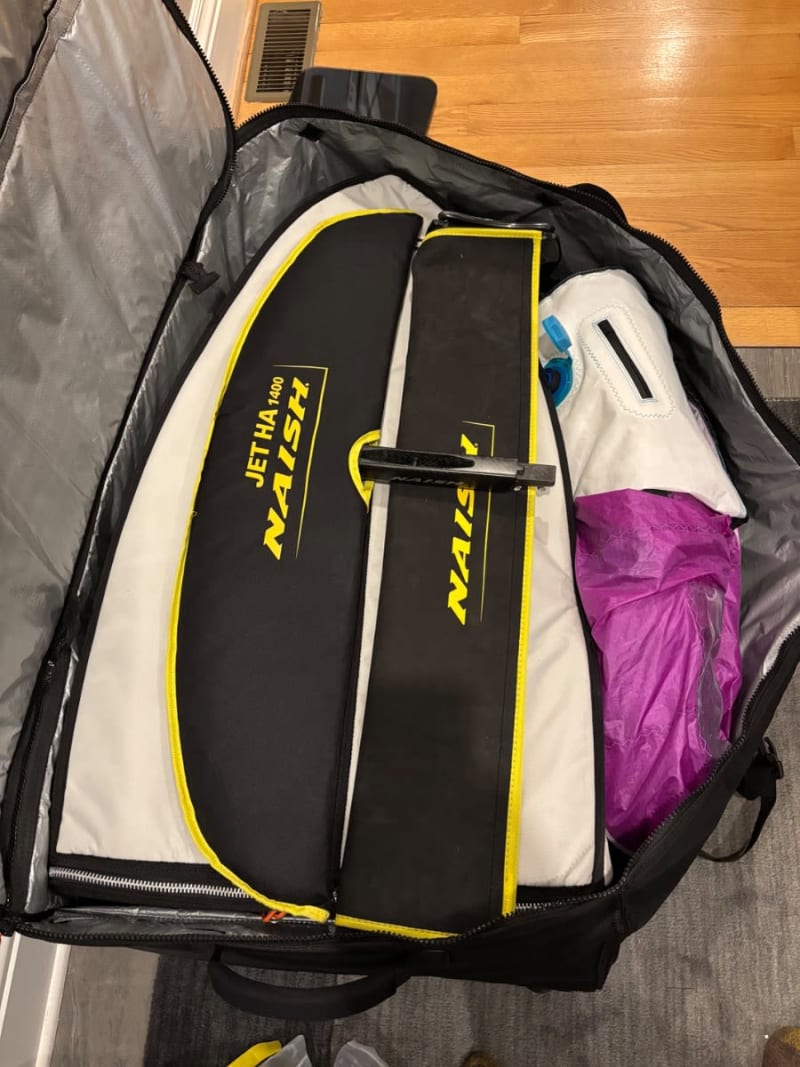
Fitting the Foil: Naish Jet HA 1400 in Its Own Protective Cases
The foil travel packing rule that every experienced foiler eventually learns, usually after one too many nicked leading edges: foil wings go into their own padded cases before they go anywhere near the main travel bag. Full stop.
The Naish Jet HA 1400 front wing and stabilizer each go into their individual Naish blade bags — padded, zippered sleeves with reinforced corners. These go into the main WAKA bag only after they're fully wrapped in their own protection. The fuselage and carbon mast go alongside them, oriented parallel to the board's length to use the available space efficiently.
The yellow trim on the Naish component bags is a small design detail that earns its keep on the beach. When you're unpacking in wind and someone's asking if you're ready, being able to grab the front wing bag by color rather than by squinting at labels is genuinely useful. It sounds trivial until it isn't.
The most common packing mistake I see — and I've made it myself — is assuming the main travel bag provides enough padding to protect foil wings directly. It doesn't. The bag protects against external impacts; the blade bags protect against internal ones. You need both layers, because a ding in a foil leading edge at altitude is a ding you'll be riding around for the rest of the trip.
Squeezing in a Wing: Yes, There's Actually Room

Squeezing in a Wing: Yes, There's Actually Room
This was the detail that genuinely surprised me about the wing foil all-in-one travel bag setup: a deflated, rolled wing actually fits.
After the board is in and the foil components are placed along the sides of the bag, there's a cavity of remaining space — not enormous, but real. A wing that's been fully deflated and rolled tight (not casually folded, but actually compressed) fits into that space. The purple kite bag that holds the deflated wing becomes the gap-filler that makes this whole one-bag concept legitimate.
The packing order matters: board in first, then foil components lined up along the sides, then the deflated and tightly rolled wing filling whatever space remains. If you try to fit the wing first, you'll fight the geometry for the rest of the pack. If the wing is only loosely rolled, it won't fit and you'll know it immediately when the zipper stops moving about six inches from closed.
What this means practically is that you can check one bag and have everything you need for a full session. That's not a trivial outcome. Most people in this tribe travel with two or three checked items and pay accordingly. The WAKA bag's ability to absorb the wing is the detail that changes the economics of the trip — and it's worth sharing with anyone you know who's on the fence about the folding board concept.
The Weight Problem: Coming in at 48 Pounds
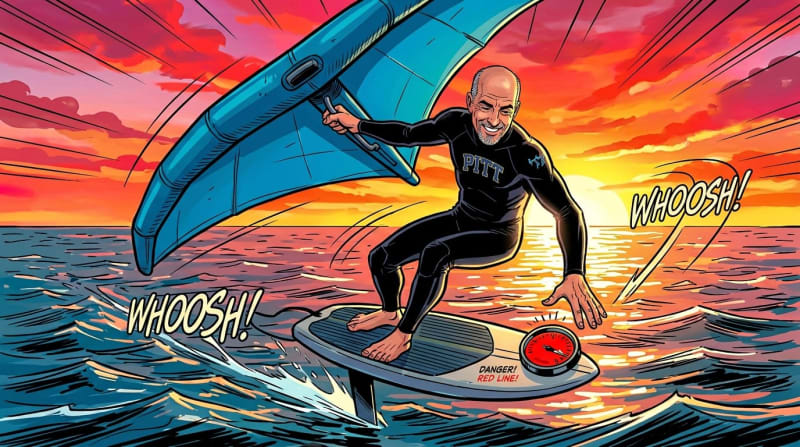
The Weight Problem: Coming in at 48 Pounds
Let's be direct about the airline weight limit for foil gear, because this is where the whole one-bag dream lives or dies.
My packed bag — board, foil set, wing, all in the WAKA airline bag — came in at 48 pounds. That is two pounds under the standard 50-pound limit for checked baggage on most US carriers. Two pounds. That is not a comfortable margin; that is a rounding error wearing a seatbelt.
Most major US carriers — United, Delta, American — charge $100 or more for bags that exceed 50 pounds. Some international carriers cap at 23kg, which is roughly 50.7 pounds, and enforce it with zero tolerance. According to the International Air Transport Association, oversize and overweight baggage fees represent one of the fastest-growing ancillary revenue categories for carriers (iata.org/en/publications/economics), which is a polished way of saying airlines are actively motivated to catch you at the threshold.
Buy a handheld luggage scale. They cost about $10 on Amazon, they fit in a jacket pocket, and they will pay for themselves the first time you catch yourself at 51 pounds in your garage instead of at the check-in counter. Weigh the packed bag at home. Every time.
The gear visible in the hallway packing photo — Duotone bags, Naish bags, helmet, accessories — represents everything that did not fit in the one-bag setup. That context matters: I made choices about what to prioritize. The helmet, wetsuit, and accessories will be going in a separate checked bag or carry-on. That's not a failure of the system; that's the honest scope of it.
What's Still Left Out (and How I'm Handling It)

What's Still Left Out (and How I'm Handling It)
The hallway packing photo tells the real story of any foil gear checked baggage strategy: there's always more gear than the elegant solution handles.
A Duotone bag, a second Naish bag, a helmet, and miscellaneous accessories are all sitting outside the WAKA bag in that photo. This is a one-bag solution for the core session kit — board, foil, wing — not a one-bag solution for your entire quiver. Anyone telling you otherwise is either packing light in a way most of us don't, or they're not bringing a wetsuit.
My current approach for the overflow: the Duotone gear goes into its own bag as a second checked item. Helmet gets worn through the airport if necessary (I've done it; the looks are worth the $35 savings) or packed into a carry-on if it fits. Wetsuit and booties can compress into a surprisingly small space inside a backpack or soft duffel.
But here's where I genuinely want to open this up: how are you handling the overflow? Everyone in this tribe wrestles with the same problem, and there's no single right answer. Some people ship gear ahead and swear by it. Some people have a one-quiver rule and pack around a single setup. Some people have figured out airline loopholes I haven't discovered yet. Drop it in the comments — this is the kind of tribal knowledge that doesn't live in any gear review.
First Look Verdict: Is the WAKA Folding Board Worth Traveling With?

First Look Verdict: Is the WAKA Folding Board Worth Traveling With?
Early answer: yes. The WAKA board review for travel purposes comes back positive on the fundamentals — the bag works, everything fits (barely, but fits), and the weight is manageable if you pack intentionally and weigh at home.
The WAKA folding wing foil board travel bag does what it promises. The folding design is what makes the 100L volume possible inside airline luggage dimensions. The airline bag's padded interior and organized layout actually accommodate a full foil set and a wing alongside the board. The two-pound margin over the 50-pound limit is not comfortable, but it's real.
What I can't tell you yet is how the board performs on the water. That's the next piece — the on-water session report from the trip this bag is enabling. The gear logistics are solved. The question now is what the Glide 99 actually feels like when it's foiling, and I'm looking forward to finding out and bringing that back to you.

If you've been putting off a wing foil trip because the gear logistics felt impossible, the WAKA folding board travel setup is proof that it's actually doable — tight, but doable. Two pounds of margin, one bag for the core kit, and a destination worth every minute of the packing process. If this community collectively got together and shared its best airline packing strategies, I'm convinced we'd have something more useful than anything a single gear review could produce. Drop your tips in the comments — what fits, what doesn't, and what trick you figured out the hard way that the rest of us still haven't learned.
Content ID: YVkL9LMXEUs9fryqrSkIpqMV
See an error? Tell us.


Comments
Share with the Community