

How to Learn Wing Foiling Behind a Boat: The 45-Degree Rope Tip That Changes Everything
The Short Version
- Angling the board 45 degrees off the boat's direction — instead of pointing it straight at the stern — turns the tow rope into a balance point you can actually lean into, and that single adjustment is what finally produced real lift.
- Trying to learn wing foiling all at once means mastering three things simultaneously: foil balance, wing control, and speed generation — and that's more than a beginner's brain and body can reliably process.
- Board volume matters more than most guides admit: riders between 70–80 kg should start on 130–140 liters, and larger riders shouldn't hesitate to go 150–160 liters to buy forgiveness for early mistakes.
- Eight miles per hour is the right boat speed for a large beginner wing (around 2500 cm²), and more throttle is almost never the answer when a rider is struggling to get up.
- Falling away from the board — not fighting it — is what keeps the heavy foil hardware from swinging back at you, and neither the author nor his son made contact with the foil across their entire early learning period on Big Wolf Lake.
The Day Lake Ontario Taught Me I Wasn't Ready

The Day Lake Ontario Taught Me I Wasn't Ready
I drove to Lake Ontario with my wing, my 135-liter board, and what I now understand was a completely unrealistic expectation of what was about to happen.
There was a little chop on the water. Not much wind. And I could barely stand up on the board with nothing in my hands. The idea that I was going to hold a 2500 cm² inflatable wing, generate enough power to move, and somehow balance all of that at the same time — it lasted about thirty seconds before I was underwater.

I drove home and made a decision: I was not touching that wing again until I could actually stand on a foil board. And the only way I was going to do that was behind a boat.
Learning wing foiling behind a boat is the tip I wish someone had given me before I left for the lake. It's also the method that every serious instructor will eventually recommend — but most beginners don't hear it until after their first humbling session in open water.
Why Separating the Skills Changes Everything

Why Separating the Skills Changes Everything
The core problem with learning to wing foil from scratch is that you're trying to master three things simultaneously: balancing on a foil board, controlling a wing, and generating enough speed to lift. That's too much for a beginner's brain and body to process at once.
Behind a boat, you have one job: learn to stand on this board and feel what the foil does underneath you. No wing. No wind. No worrying about anything except balance and lift. According to tow foiling instructors, tow foiling lets you focus purely on balance and lift at low speeds, in a controlled environment — and that controlled environment is exactly where the real learning happens.
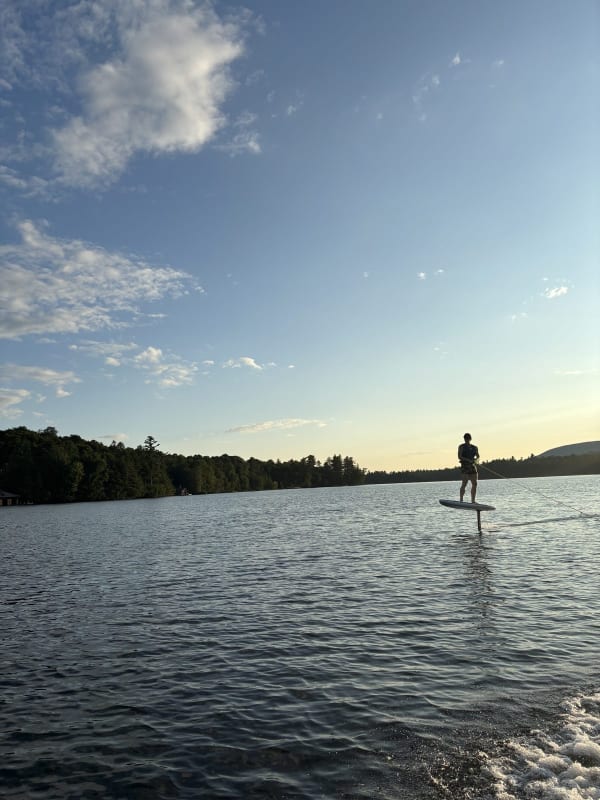
Breaking wingfoiling down into its component parts and dealing with one aspect at a time results in faster progression. My son and I figured this out together over multiple sessions on Big Wolf Lake in the Adirondacks — which made the failures considerably more entertaining. There were a lot of failures.
What Size Board and Wing for Beginners

What Size Board and Wing for Beginners
before you ever get behind a boat, gear selection matters more than most people admit. Get it wrong and you'll fight your equipment through every session instead of learning.
I was on a 135-liter board — large even by beginner standards — and still found balance genuinely difficult in the early sessions. That's the right direction to err. For people between 70–80 kg, a board around 130–140 liters is ideal for learning; if you're larger, don't hesitate to go 150–160 liters. The extra volume forgives a lot of early mistakes.
For the front wing, I used a 2500 cm² wing — one of the largest beginner options available. Big front wings generate lift at slower speeds, which is exactly what you want behind a slow-moving boat. For large, high-volume wings, 8–12 mph is the right boat speed range — and when you're truly starting out, stay at the lower end. We settled on about 8 mph and even that felt fast in the first few runs.

The bigger the gear, the more forgiving the learning curve. You can always downsize once you're actually foiling.
The Setup: Board, Speed, and Rope

The Setup: Board, Speed, and Rope
Not all boat starts are created equal. Get the setup wrong and you'll be frustrated before you factor in your own balance problems.
Speed needs to stay slow. Eight miles per hour was our target, and the boat driver needs to understand that more speed is almost never the answer when the rider is struggling. Resist the instinct to throttle up. The board has suction to the water, so you need enough speed to break free and begin foiling — but once up, you can actually foil at a lower speed.
Any boat works — pontoon, outboard, it doesn't matter. You can foil behind almost anything — a pontoon boat, a small boat with an outboard motor, even a ski. What matters is a driver who is patient, attentive, and willing to hold a painfully slow speed for as long as it takes.

Rope length should put you well behind the wake, in clean flat water. The turbulence directly behind the boat is one more variable you don't need in the early sessions.
The Breakthrough: Stop Pointing the Board at the Boat
The Breakthrough: Stop Pointing the Board at the Boat
This is the tip that changed everything for us — and it took several sessions to figure out. You won't find it in most beginner guides.
The instinct when you first get behind a boat on a foil board is to point the board directly behind the stern, rope running straight out in front of you. It feels logical. It looks like water skiing.
It's wrong.
When the board points straight at the boat, the rope runs directly forward and offers zero lateral stability. The slightest weight shift left or right and you're off. You're balancing on an unstable platform with nothing to lean into — which is exactly as hard as it sounds.
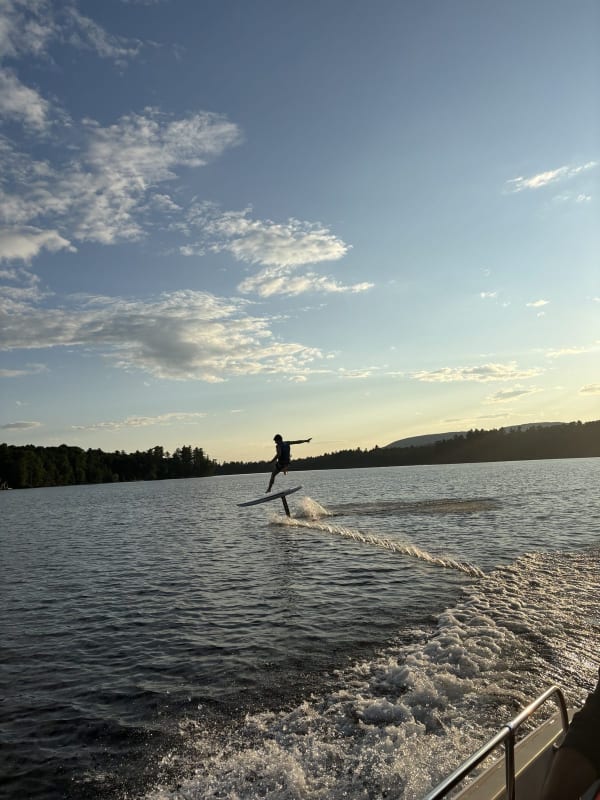
What works — what actually taught us to get up and stay up — is angling the board about 45 degrees away from the boat's direction of travel. When the board is at that angle, the tow rope now runs diagonally in front of you. You have something to lean into. The rope becomes a balance point, not just a speed source. You can put weight into it when you need to, ease off when the foil starts to lift, and actually feel what the board is doing underneath you.

Ride the direction you're most comfortable — regular or goofy. Just make sure that rope is running out in front of you at an angle, not straight ahead, before you signal the driver to go.
Once we figured that out, the board stopped dragging, the foil started doing its job, and the first real lift happened.
The First Time You Come Off the Water

The First Time You Come Off the Water
There is nothing that prepares you for the moment the foil lifts and you are suddenly several feet above the surface of the lake moving at speed with nothing between you and the water but a carbon mast.
The first few times, we had absolutely no idea what to do. Balance that had felt impossible on the surface suddenly felt different — more alive, more responsive, and considerably more terrifying. The foil reacts to the smallest shift in weight.
Look at my early photos and the posture tells the whole story. Crouched over the board like bracing for impact. Standing tall, relaxed, and balanced — the way experienced wing foilers look when they're gliding — that comes much later. In those first sessions, survival mode was the goal.

What you're actually doing in those early runs, even when it doesn't feel like it, is building the neural map for a completely new kind of balance. Every session adds to that map. Especially the ones that end badly.
On Falling: Give In to It

On Falling: Give In to It
The wipeouts on a foil board look dramatic from the boat. When you come off at height you are genuinely airborne — several feet above the water — and from shore it looks like something went badly wrong.
In practice it's almost always fine. The key is this: do not fight the fall.
When you feel yourself going, give in to gravity. Let your body fall away from the board. The natural arc of an unresisted fall takes you well clear of the board and the foil. In all our sessions on Big Wolf, neither my son nor I ever made contact with the foil on a wipeout.
Where injuries happen is when riders fight it. You tense up, grab for the board, try to correct at the last second — and that's when the board flips, the foil swings back toward you, and the geometry stops working in your favor. Fall away from the board — jump in the opposite direction. The foil is heavy hardware. You do not want it coming back at you.
Fall like you mean it. Fall away. A helmet and impact vest are worth wearing in the early sessions — not because falls are likely to injure you, but because they let you fall with more confidence.
From the Boat to the Wing

From the Boat to the Wing
Getting behind a boat didn't just teach me to foil. It taught me what foiling actually feels like — the lift, the balance point, the communication through your feet — in an environment where I could focus on exactly that without managing anything else.
When I eventually put the wing back in my hands on a real wind day on Big Wolf, it wasn't starting over. The foil balance was already there. The 45-degree angle was already muscle memory. I already knew to give in when I fell.
That first session with the Naish wing after the boat training was completely different from the Lake Ontario disaster. I knew what the board was supposed to feel like when it was working.
If you're brand new to wing foiling and you have access to a motorboat and a patient driver, start there. Get a big board — 130 liters or more. Use a large front wing. Go slow, around 8 mph. Angle the board 45 degrees off the boat's line. Eat some water — that's part of it.
What's waiting on the other side of those sessions — the quiet, the speed, the feeling of flying an inch above a lake in the Adirondacks at sunset — is worth every wipeout it takes to get there.
What would your first run behind a boat feel like if you already knew what the foil was supposed to do?
Content ID: ZQ6ZumKZCdYSq0tiHGdQ5aE3
See an error? Tell us.
Comments
Share with the Community