
The Midlength Revolution: Why One Board May Be All You Need in 2026
The Short Version
- A midlength wingfoil board generates glide before the foil lifts — meaning earlier takeoffs, more flight time in marginal conditions, and tighter carving turns compared to a compact board.
- Three boards tested over a year: Armstrong midlength (Adirondacks, low wind), Starboard Above (Lake Ontario, foil drive), and Waka Glide 99L (travel to Florida and St. Martin).
- The Armstrong won on all-around comfort — its wider deck and padding placement is noticeably easier on your shins during re-mounts after a crash than the Starboard Above or Waka.
- Every major brand in 2026 now has a midlength — Naish Chimera, GONG Cruzader Squash, Appletree Skipper — signaling a genuine industry shift, not a niche trend.
- Midlengths are not beginner boards — if your water starts aren't consistent yet, the reduced off-foil stability will frustrate more than it helps.
- The Waka Glide solves a problem no other midlength does: it folds in half for travel, yet rides like a full rigid board.
The Quiver Problem Nobody Wants to Admit

The Quiver Problem Nobody Wants to Admit
Ask any intermediate wing foiler how many boards they own and watch what happens. There's a pause. Maybe a slight wince. Then a number that's higher than they planned for when they started two years ago.
It happens to everyone. You buy a beginner board that's wide and stable and gets you flying. Then you buy something smaller because you want more performance. Then something longer because you want to chase bumps or ride in lighter wind. Before long, you have three boards, a garage problem, and a spouse with opinions about it.
The midlength board is the industry's answer to this — and in 2026, it's no longer a niche solution. Every major brand has one. Riders who've tried them are talking about them. And for intermediate riders in particular, the midlength may genuinely be the most important equipment decision in the sport right now.
I've spent the last year riding three of them across very different conditions. Here's what I found.
What a Midlength Actually Does Differently

What a Midlength Actually Does Differently
The traditional wingfoil board is compact and wide — designed for stability, easy water starts, and forgiving touchdowns. It works well, but it has a ceiling. In light wind, you're fighting to get up. In choppier conditions, every touchdown feels like a reset. And if you want to do a downwind run or ride genuine swell, a compact board is fighting its own shape.
A midlength changes the geometry. GONG describes the difference well: longer, narrower shapes generate glide before the foil lifts — which means you get airborne earlier, with less pumping, in less wind. Once on foil, the narrower outline tracks better through turns and rewards committed carving. Touchdowns are more forgiving because the board has length to absorb the landing rather than just dropping back flat.
Here's how the key performance characteristics compare between a typical compact board and a midlength:
The trade-off is real: midlengths are less portable, tippier off foil, and demand more from your balance. They're not beginner boards. But for someone who has their water starts dialed and wants more — more flight time, more range, more fun in marginal conditions — the midlength opens doors that a compact board can't.
The question isn't whether a midlength is better. It's whether you're ready to ride one.
Three Boards, Three Sessions — What I Found

Three Boards, Three Sessions — What I Found
I came to midlengths the way most people do: through a specific problem. My lake house in the Adirondacks has inconsistent, often frustratingly light wind on an inland lake. My compact board was leaving me stranded on flat water more sessions than not. I needed something that could generate flight earlier.
Armstrong midlength — ~99L, 22" wide, Adirondacks
The Armstrong was my first experiment. I paired it with a 7-meter wing specifically for those low-wind days on the lake, and the combination worked better than I expected. The shape is relatively wide for a midlength — around 22 inches — which gave me enough stability to feel confident off foil while still delivering the glide advantage I was chasing. In marginal conditions, it got me up when the compact board wouldn't have.
What I didn't expect was how much it improved my turns once on foil. The narrower outline compared to my compact board translated directly to sharper carving and a more committed, surf-inspired feel. I started riding differently on it — more intentionally, more athletically.
Starboard Above, ~100L, blue carbon — Lake Ontario, foil drive
The Starboard Above is narrower than the Armstrong — around 100 liters in the blue carbon construction — and closer to what a serious intermediate or advanced rider would choose. I used it primarily on Lake Ontario in Rochester on low-wind days with a foil drive assist, and I want to be honest: it's tippy. Standing on it off foil requires real balance. You need to be a solid intermediate to pull off a water start on something this narrow without drama.
That said, once on foil it's exceptional. The tracking is clean, the response is immediate, the turns are tighter than anything I'd ridden before. The Above rewards investment in your riding. I didn't regret buying it — I just knew exactly what I was getting into.
One note worth flagging: the Above was noticeably harder on my shins than the Armstrong — not during touchdowns, but during re-mounts after a crash. When you're back in the water, getting your chest on the board and kicking to stabilize before standing, the rail geometry and padding placement on the Above made that process rough on my shins in a way the Armstrong never did. The wider, more padded deck on the Armstrong makes the re-mount phase noticeably more comfortable.
Waka Glide 99L — travel, Florida and St. Martin
The Waka Glide is the one I didn't see coming. I bought it purely for travel — it folds in half via a patent-pending carbon-kevlar living hinge, fits in a bag that goes in a car trunk or overhead bin, and was named one of the top five innovations at AWSI 2025. I took it to Florida and St. Martin, and it genuinely performs like a rigid board. The MACkiteboarding crew reviewed it independently and landed on the same conclusion: so good you forget it folds.
At 6'9" and 99 liters, it rides like a proper midlength. Early liftoff, clean glide, committed carving. What I didn't expect is how much I'd come to love the shape beyond travel — it's become one of my favorite boards to ride full stop.
The Waka had the same re-mount issue as the Above. Getting back on after a crash — chest down, kicking to stabilize — was harder on my shins than the Armstrong. I still don't fully understand the geometry behind it, but it was consistent across both boards. If you're at a stage where you're still crashing and re-mounting regularly, it's worth factoring in.
Bottom line across all three: every midlength delivered on the promise. Earlier takeoffs, more flight time in marginal conditions, tighter turns on foil. The Armstrong edges the others for all-around comfort — specifically in the re-mount phase after a crash, where its wider deck and padding placement is noticeably more forgiving on your shins than the Above or the Waka.
What the Brands Are Building in 2026

What the Brands Are Building in 2026
The midlength trend in 2026 isn't just one or two brands experimenting. It's a coordinated industry shift. Riders have spoken, and the response from manufacturers has been thorough.
Naish's Chimera is the most explicitly marketed quiver-killer on the market right now. Naish describes it simply: "One board. All purpose." It's built for wing, surf, downwind, and tow — a centered foil box and two-stage rocker that lifts early and tracks smooth. The marketing is bold, and from what riders are reporting, it largely delivers.
GONG's 2026 Cruzader Squash is GONG's take on a compact midlength — surf-oriented DNA with downwinder glide built in. The 2026 refresh adds recessed decks, optimized strap placement, and shapes that are narrower at the hull while maintaining "aircraft carrier" outlines for stance comfort. GONG is one of the most thoughtful midlength designers in the game right now.
Appletree's Skipper Midlength was built specifically in response to rider demand for a one-board quiver. It's designed for prone, wing, and parawing — a genuinely cross-discipline shape that performs in lighter wind and rewards progression.
And then there's the Waka Glide, which adds a dimension none of the others can match: foldability. For anyone who travels with gear, it solves a problem that no other midlength addresses.
Is the Midlength Right for You?
Is the Midlength Right for You?
Honest answer: it depends on where you are in your riding.
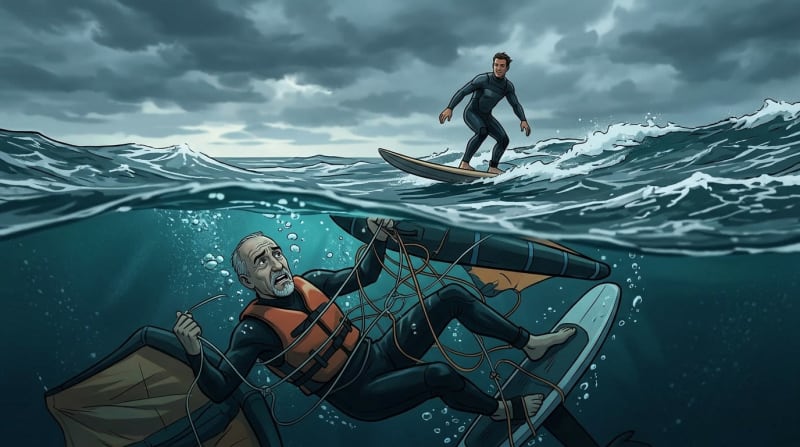
If you're still learning water starts — still spending significant time off foil, still getting your wing control dialed — a midlength will make your life harder before it makes it better. The reduced stability off foil is real, and a board that demands more from your balance before you're ready for it is just frustrating gear.
But if you've been riding for a season or two, your water starts are consistent, and you're starting to feel the ceiling of your compact board — especially in light wind or when you want to carve — then a midlength is worth serious consideration.
The intermediate plateau in wingfoiling is a real thing. You're flying reliably but you want more from each session. You want earlier takeoffs in marginal conditions. You want turns that feel more like surfing and less like banking. You want to chase downwind bumps without switching equipment. A midlength addresses all of it in a single shape.
What I've found is that the more sessions I put on these boards, the less I want to go back. The Armstrong stays home at the lake house where it belongs. The Waka travels with me. The Above comes out when I want to push my riding somewhere new. Three boards that each do something specific, all of them midlengths.
The quiver problem didn't get smaller. But the riding got a lot better.
What would it mean for your sessions if you could get on foil two pumps earlier, in conditions you're currently sitting out?
Content ID: iDUKFDFOherqTLCHxogXsX36
See an error? Tell us.
Comments
Share with the Community