
Wingfoil Fitness: The Off-Water Training That Will Actually Improve Your Sessions
The Short Version
- Beginners push to roughly 90 percent of their maximum physical capacity just to achieve basic riding safety, which means even intermediate riders are carrying a significant physiological load every session.
- Shoulder and arm fatigue ends sessions earlier than any other factor — the front arm positions the wing while the back arm controls power, creating continuous active demand that outlasts most people's endurance.
- The core's job in wing foiling is not flexibility or movement but transmission — it is the rigid link that carries force from the wing through to the board, and anti-rotation exercises like Pallof presses train that specific demand better than crunches ever will.
- Bulgarian split squats transfer unusually well to foiling because they build single-leg stability under load, which mirrors the uneven weight distribution riders manage through every turn on the water.
- Two to three off-water sessions per week is the coaching community's consistent recommendation, with the added guidance to maintain rather than progress weights during high-water-time weeks so training does not compete with time on the foil.
There is a predictable plateau that catches intermediate wing foilers — you are getting on foil consistently, you know what a good jibe feels like, but something is not clicking. Sessions end earlier than they should. the jibe still falls apart when you are tired. Progress has slowed. Before changing your gear, the answer is usually in the gym, not on the water. Wingfoil fitness training built around the specific demands of the sport transfers directly to what happens when the wind fills the wing.
Why Off-Water Training Actually Transfers to Your Sessions

Why Off-Water Training Actually Transfers to Your Sessions
Wing foiling is deceptively physical. What looks from shore like an effortless glide is, according to sports scientists who have studied foiling biomechanics, a continuous demand on balance, coordination, and strength that pushes beginners to roughly 90 percent of their maximum physical capacity just to achieve basic riding safety. Even at intermediate level, every gust, every chop, every transition demands micro-adjustments from muscles that most land-based fitness routines never specifically train.
Locals Crew, a wingfoil instruction program, describes the primary muscle groups in wing foiling as the deltoids and upper pectorals, trapezius, biceps and triceps, back and lumbar, abdominals, and most of the muscles of the legs — effectively the whole body, but with a specific emphasis that differs from general fitness. The traction from the wing travels through your arms, through your core, and into the board through your legs. Every one of those links has to be strong enough to hold that chain together when conditions get difficult.
Here is how the primary demand falls across body regions during a typical session:
The good news: the muscle groups wing foiling demands most are trainable off-water with straightforward exercises. You do not need a specialized gym or elaborate equipment to close the gap between your current fitness and the sessions you want to have.
The Core: Your Connection Between Wing and Board

The Core: Your Connection Between Wing and Board
Every source in wing foiling coaching points to the same foundation. Ion Club's physical analysis puts it plainly: the abdominal muscles are constantly engaged to maintain a stable and fluid posture, and the core is what transmits force between upper and lower body. Without a trained core, power from the wing leaks out before it reaches the board — and balance in chop becomes reactive rather than controlled.
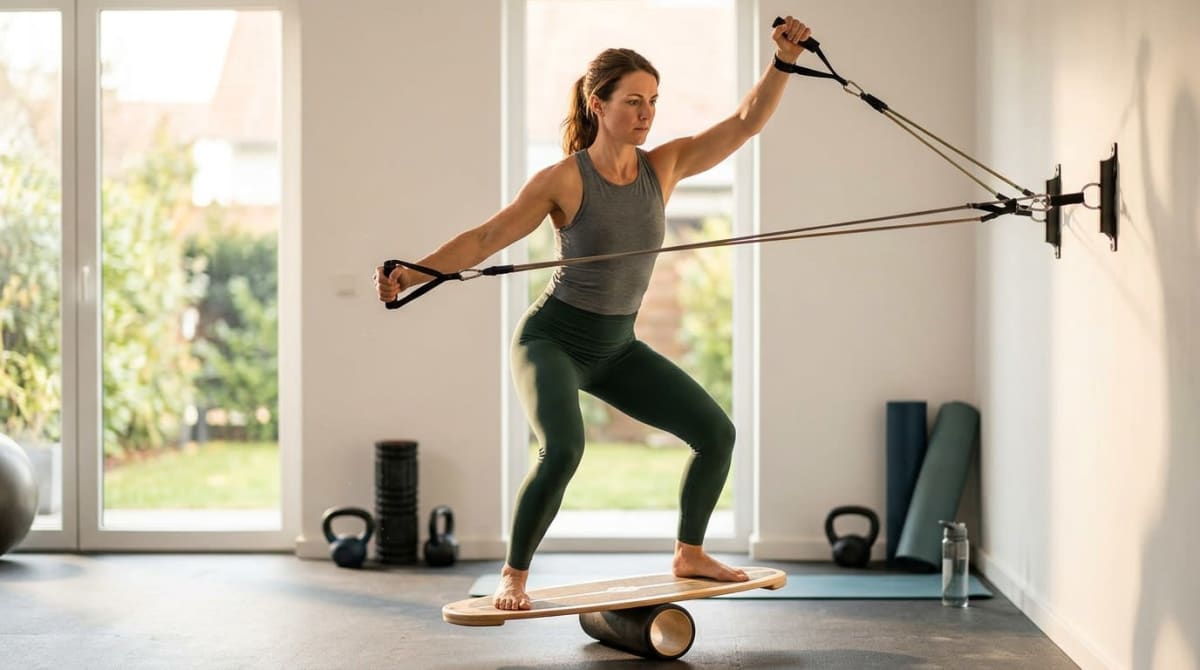
The exercises that transfer most directly are not crunches. They are anti-rotation and stabilization movements: planks with shoulder taps, dead bugs, Pallof presses with a resistance band, and hanging leg raises. Wingpassion's coaching guide specifically recommends the ab wheel rollout and bodyweight walkouts because they train the core as a rigid connection between arms and legs — exactly the chain you are trying to hold together when the wing loads up in a gust.
Yoga and Pilates are worth taking seriously here, not as alternatives to strength training but as complements. Kite Wing and Foil's training guide identifies rotational core strength specifically as one of the four pillars of wing foiling fitness. That rotational demand — staying stacked through the torso while your arms swing the wing and your legs adjust on the board — is something mat-based training develops better than any gym machine.
What would your sessions look like if your core was never the limiting factor — if you could stay composed through a set of gusts and still have the stability left to nail the jibe at the end?
Legs and Balance: Where Foiling Is Really Won or Lost

Legs and Balance: Where Foiling Is Really Won or Lost
The front-to-back balance demand of foiling is unlike any other board sport. Foil Surfing UK's physical analysis notes that foilers spend far longer in an engaged riding stance than surfers, with the added dimension of controlling pitch — the front-to-back tilt of the board — entirely through weight shifts and leg position. Quads, hamstrings, glutes, and calves are all working continuously, not in explosive bursts.
The training implication is endurance over max strength. SROKA's coaching team recommends squats and lunges with medium-light loads and high repetitions — the goal is muscular efficiency and endurance, not bulk. Bulgarian split squats carry particularly well to foiling because they train single-leg stability under load, mimicking the uneven weight distribution you manage through every turn.
For balance specifically, the Indo board is the most cited off-water tool across the coaching community. Blue Planet Surf recommends squats on the Indo board or BOSU ball combined with box jumps for explosive leg strength — the pop and commitment required to get on foil in light wind demands that combination of stability and power. Slacklining develops similar proprioception with the added benefit of being usable anywhere.
Shoulders and Grip: The Limiting Factor Most Riders Hit First

Shoulders and Grip: The Limiting Factor Most Riders Hit First
Ask any intermediate wing foiler what ends their sessions and the answer is usually the same: arms. Poole Harbour Watersports describes holding the wing in gusty conditions as one of the most intense upper body demands in any water sport — and it is the first place fatigue accumulates, long before the legs or core give out.
The shoulder complex in wing foiling does two distinct jobs simultaneously: the front shoulder positions the wing's height and angle, while the back arm controls power by adjusting distance to the body. Wing coach David Kano's technique analysis describes this as continuous active engagement from the deltoids and biceps, not just passive holding. Training those muscles for endurance — not just strength — is the key distinction.
Pull-ups and dead hangs are the most cited exercises across the coaching community for building the shoulder and grip endurance wing foiling demands. Band pull-aparts and face pulls protect the rotator cuff, which takes stress every time the wing loads in a gust. SROKA specifically calls out the scapular fixators — the muscles that hold your shoulders back as the wing pulls you forward — as among the most important and most undertrained muscle groups for wingfoilers. Rows in all their variations — cable, band, TRX — address this directly.
Grip endurance is worth training separately. Hanging from a pull-up bar for time, farmer carries, and dead hangs develop the forearm and hand endurance that determines how long you can stay on the wing before your hands give out.
Putting It Together: A Simple Weekly Wingfoil Fitness Training Framework

Putting It Together: A Simple Weekly Wingfoil Fitness Training Framework
The training frequency recommendation across the coaching community converges on two to three sessions per week off-water, timed so they do not compete with your water time. Kite Wing and Foil suggests that in high-water-time weeks, you maintain weights rather than progress them — training is only half the equation, and recovery is what lets the adaptation happen.
A simple structure that works:
A single strength session might look like: bodyweight walkouts (3 sets), Bulgarian split squats (3x12 each leg), TRX rows (3x15), Pallof press (3x12 each side), dead hang (3x30 seconds). Done in under 45 minutes, two or three times a week, that program addresses every primary demand of the sport.
The riders who improve fastest off-water are not the ones grinding through elaborate gym programs. They are the ones who show up consistently for simple work that directly mirrors what foiling asks of them. The jibe does not fall apart at the end of a session because of gear or luck — it falls apart because of fatigue in specific muscles that off-water training can fix. What would it mean to show up to your next session knowing that fitness was no longer the variable?
Content ID: nx175MC4uRPsGOisJftJPaq7
See an error? Tell us.
Comments
Share with the Community